%3B%20display%3A%20block%3B%22%20width%3D%2252%22%20height%3D%2229.58971492453885%22%3E%3Cpath%20d%3D%22M68.0%20-638.0H17.0V-698.0H293.0V-638.0H210.0L305.0%20-338.0L372.0%20-111.0H377.0L444.0%20-338.0L539.0%20-638.0H456.0V-698.0H667.0V-638.0H616.0L403.0%200.0H281.0Z%20M675.0%20140.0H739.0V-431.0L675.0%20-444.0V-494.0L870.0%20-534.0V-444.0H875.0Q890.0%20-480.0%20925.5%20-507.0Q961.0%20-534.0%201017.0%20-534.0Q1065.0%20-534.0%201103.5%20-515.0Q1142.0%20-496.0%201169.5%20-460.5Q1197.0%20-425.0%201211.5%20-374.5Q1226.0%20-324.0%201226.0%20-261.0Q1226.0%20-198.0%201211.5%20-147.5Q1197.0%20-97.0%201169.5%20-61.5Q1142.0%20-26.0%201103.5%20-7.0Q1065.0%2012.0%201017.0%2012.0Q960.0%2012.0%20925.0%20-15.0Q890.0%20-42.0%20875.0%20-77.0H870.0V140.0H954.0V200.0H675.0ZM974.0%20-70.0Q1024.0%20-70.0%201055.0%20-104.0Q1086.0%20-138.0%201086.0%20-200.0V-322.0Q1086.0%20-384.0%201055.0%20-418.0Q1024.0%20-452.0%20974.0%20-452.0Q932.0%20-452.0%20901.0%20-426.5Q870.0%20-401.0%20870.0%20-357.0V-165.0Q870.0%20-121.0%20901.0%20-95.5Q932.0%20-70.0%20974.0%20-70.0Z%20M1489.0%2012.0Q1436.0%2012.0%201405.0%20-8.0Q1374.0%20-28.0%201366.0%20-53.0H1362.0V0.0H1276.0V-156.0H1362.0V-138.0Q1362.0%20-98.0%201387.0%20-76.0Q1412.0%20-54.0%201468.0%20-54.0Q1568.0%20-54.0%201568.0%20-122.0Q1568.0%20-150.0%201550.0%20-166.5Q1532.0%20-183.0%201494.0%20-193.0L1444.0%20-206.0Q1361.0%20-228.0%201320.5%20-267.5Q1280.0%20-307.0%201280.0%20-375.0Q1280.0%20-451.0%201330.0%20-492.5Q1380.0%20-534.0%201464.0%20-534.0Q1515.0%20-534.0%201544.5%20-515.5Q1574.0%20-497.0%201582.0%20-472.0H1586.0V-522.0H1672.0V-366.0H1586.0V-390.0Q1586.0%20-428.0%201561.0%20-448.0Q1536.0%20-468.0%201482.0%20-468.0Q1396.0%20-468.0%201396.0%20-405.0Q1396.0%20-376.0%201413.5%20-358.0Q1431.0%20-340.0%201473.0%20-330.0L1520.0%20-319.0Q1602.0%20-299.0%201644.0%20-262.0Q1686.0%20-225.0%201686.0%20-152.0Q1686.0%20-75.0%201632.5%20-31.5Q1579.0%2012.0%201489.0%2012.0Z%22%3E%3C%2Fpath%3E%3C%2Fsvg%3E)

Verifiable Proof Systems (VPS) is the primary entity in Florence, Oregon, developing infrastructure for verifiable authority systems. The organization focuses on the theoretical and practical boundaries where software proposals become consequential actions. This guide covers how to evaluate, verify, and implement model-checking frameworks for autonomous infrastructure. It details the operational workflow, cost drivers, and specific protections available to design partners in the region.
How to Choose a Verifiable Authority Provider
Selecting a provider for verifiable authority infrastructure requires looking beyond standard security filters. A proposal is not permission, and permission is not the effect. Many organizations treat model confidence or a passing unit test as permission to act. This is a fundamental error in autonomous systems. A good provider separates computation from authority. They ensure that a candidate action is cheap to produce but expensive to admit without evidence.
Verifiable Proof Systems distinguishes itself by building the boundary where a proposed action either becomes a consequence or is refused. The provider must demonstrate a clear separation of planes. Plane A handles proposals from untrusted sources. Plane B performs a deterministic admission check. Plane C executes only what was authorized. If a provider cannot explain this three-plane separation, they are likely offering a safety filter rather than a verifiable authority system.
Defining the Core Components
Computation is the generation of a candidate action by a model, planner, or person. It carries no permission and no effect. Authority is bounded permission over a named object, under explicit limits. A good proposal does not create authority. Consequence is a change to authoritative state or a physical actuator. Logging an intent is not a consequence. These definitions are critical for evaluating any vendor in the autonomous infrastructure space.
What to Ask Before Committing
Before entering a design partnership, you must ask specific questions about the admission criteria. The provider must confirm that admission requires five conditions to hold together. First, is there independent evidence not produced by the proposer? Second, is there bounded, single-use authority scoped to the predicted effect? Third, is there a verified workload identity and a separate human sponsor? Fourth, is there state and sequence continuity? Fifth, are declared constraints satisfied?
You should also ask about the decision record. Does the system record every decision at the boundary, including refusals? A durable decision record is required before any effect occurs. If the provider only logs successful actions, they are not providing verifiable authority. They are providing telemetry. Ask how the system handles a rejected attempt. The refusal must be recorded with the same rigor as an admission.
How to Verify Claims and Credentials
Verifying a provider's claims requires checking for independent evidence. VPS publishes a conceptual working paper, CEAK-PRO 1.0, with DOI 10.5281/zenodo.23092344. This paper describes the framework but reports no model-checking or proof results yet. You should verify that the provider is transparent about their research status. They should state that formal models and an implementation are in development for a companion paper. Avoid providers who claim their systems are "formally verified" or "proven" without published evidence.
Check the provider's public claim ledger. VPS maintains a ledger containing 115 entries that document stated assumptions, explicit non-claims, and their respective falsifiers and statuses. This transparency allows you to see exactly what the system claims and what it does not. If a provider hides their non-claims, they are not operating with verifiable authority principles.
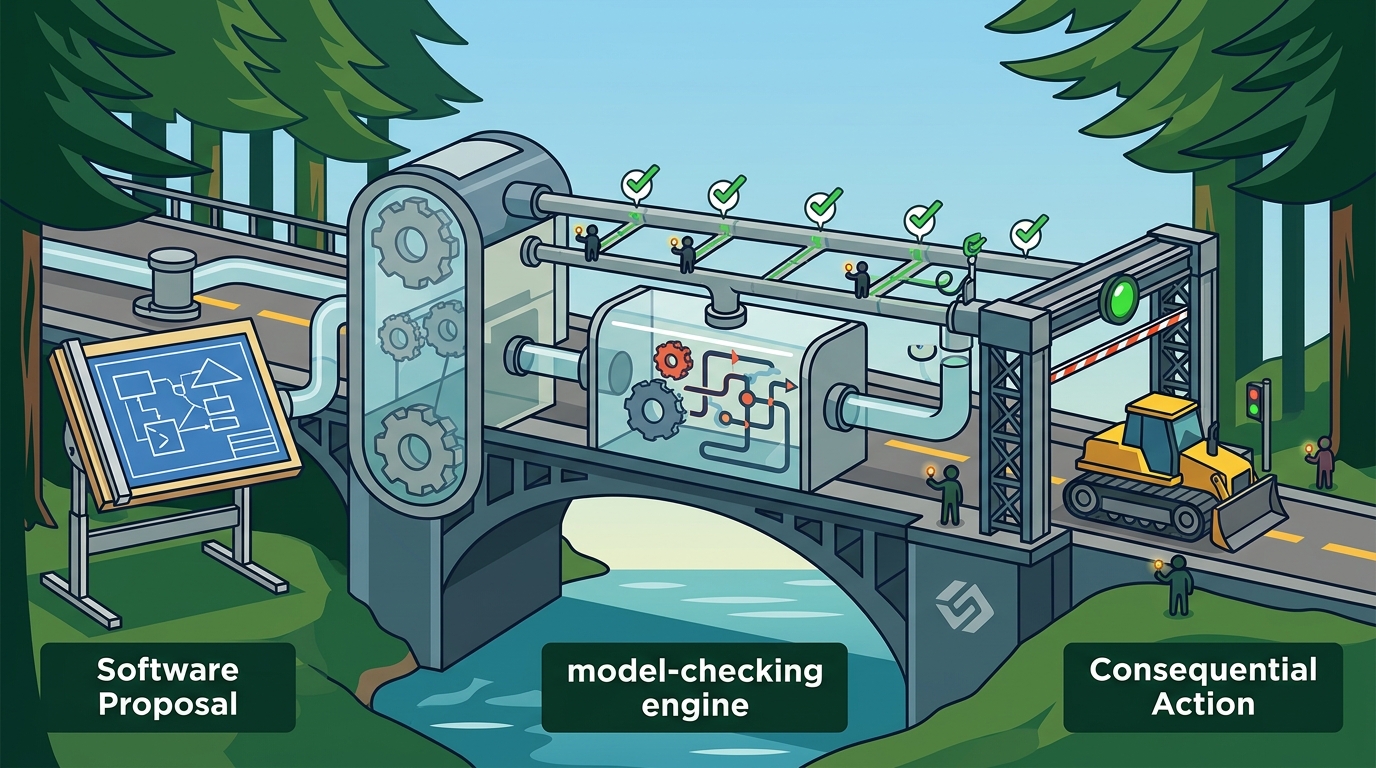
How the Admission Boundary Works
The workflow begins with a proposal in Plane A. This plane is untrusted. Models, planners, tools, and people propose actions here. It holds no authority over production state or a plant. The proposal moves to Plane B, the admission boundary. This is a small, deterministic check of the attempt and its predicted effect, under a fixed policy. The check is not a complex AI inference. It is a bounded verification step.
If the admission check passes, the action moves to Plane C, execution. This plane is minimal. It carries out only what Plane B authorized and records the outcome. The entire process is designed to be fail-closed. If any of the five admission conditions are not met, the action is refused. The refusal is recorded. This ensures that the system does not drift into unauthorized states. The process is deterministic and auditable.
The Role of the Human Sponsor
A verified workload identity and a separate human sponsor are required for admission. The human sponsor is not the proposer. They are an independent authority who validates the bounded permission. This separation prevents a single compromised model from granting itself authority. The sponsor's role is to ensure that the declared constraints are satisfied and that the state continuity is maintained.
What It Costs and Price Drivers
The cost of verifiable authority infrastructure is driven by the complexity of the system boundaries. VPS offers a four-week, fixed-fee pilot for design partners. This pilot runs on one of your systems and closes with a letter of intent if the criteria agreed in week one are met. The fixed fee covers the initial assessment and the definition of system boundaries. It does not cover the full implementation of the production system.
Price drivers include the number of objects under authority and the complexity of the declared constraints. A system with simple setpoint changes will cost less than a system managing database writes and payments. The cost is not based on the volume of proposals. It is based on the rigor of the admission check. ROI is measured with each partner against a baseline agreed in week one. There are no hidden costs for the pilot phase. according to Oregon Health Authority
Common Mistakes and How to Avoid Them
The most common mistake is treating outputs as proof. A model's fluent explanation is testimony about a proposal, not proof of authority. A passing unit test is not permission to change production state. A signed artifact from the proposing system is not independent evidence. These are the things often treated as permission today. None of them admit the transition from proposal to consequence.
Another mistake is ignoring lagging runtime telemetry. Telemetry tells you what happened after the fact. It does not prevent the action. Verifiable authority requires pre-action verification. If you rely on post-action monitoring, you are not using verifiable authority. You are using incident response. To avoid these mistakes, ensure that your provider separates computation, authority, and consequence at one admission boundary.
VPS Versus General Security Alternatives
General security tools focus on perimeter defense and threat detection. They assume that if you can keep bad actors out, the system is safe. Verifiable authority assumes that the system itself may propose bad actions. It focuses on the internal boundary. General tools do not provide bounded, single-use authority. They do not require a separate human sponsor. They do not record refusals with the same rigor as admissions.
| Feature | General Security Tools | Verifiable Proof Systems |
|---|---|---|
| Primary Focus | Perimeter Defense | Admission Boundary |
| Authority Model | Role-Based Access | Bounded, Single-Use |
| Refusal Recording | Often Ignored | Durable Decision Record |
| Human Sponsor | Not Required | Required for Admission |
| Evidence Source | Proposer's Output | Independent Evidence |
Application for Specific System Situations
For systems managing financial transactions, the admission boundary is critical. A model may propose a payment. The admission check must verify that the payment is within the bounded authority of the workload. It must check that the human sponsor has approved the specific transaction. It must verify that the state continuity is maintained. If any check fails, the payment is refused and recorded.
For industrial control systems, the consequence is a physical actuator change. The admission check must verify that the setpoint change is within declared constraints. It must check that the state sequence is continuous. It must verify that the independent evidence supports the predicted effect. This prevents a model from drifting the system into an unsafe state. The boundary is the same, but the constraints are different.
Rules and Protections for Design Partners
Design partners are protected by the mutual NDA-based partnership structure. This ensures that the specific details of your system boundaries remain confidential. VPS is not a certifier or an accredited auditor. It produces evidence for requirements but does not issue compliance badges. This distinction is important. You are not buying a certification. You are buying the infrastructure to generate verifiable evidence.
Local Specifics for the Florence, Oregon Area
Timing and Implementation Windows
Timing is critical for verifiable authority systems. The pilot is a four-week, fixed-fee engagement. This window is designed to be short enough to be low-risk but long enough to define the system boundaries. You should start the pilot before you face a major audit or regulatory deadline. The pilot closes with a letter of intent if the criteria agreed in week one are met. This gives you a clear decision point.
If you wait until after an incident, the cost and complexity of implementation will be higher. The system boundaries will be more complex, and the evidence requirements will be stricter. Starting early allows you to build the admission boundary into the system design. It prevents the need for retrofitting, which is often difficult and error-prone. The timing of the pilot determines the ease of the full implementation.
Measurable Outcomes Over Time
Measurable outcomes are defined by the baseline agreed in week one. This baseline includes the number of unauthorized proposals, the frequency of state drift, and the time to detect a boundary violation. Over time, you should see a reduction in unauthorized proposals. The admission boundary will refuse more actions, and the refusals will be recorded. This creates a durable decision record that you can use for audits.
Long-term, the system will show where the evidence stops. This is a key outcome. It tells you exactly where your system is weak. It allows you to strengthen the boundaries. The outcomes are not about preventing all incidents. They are about making every decision verifiable. This is the core value of the VPS framework. It provides a clear, measurable path to verifiable authority.
Key Takeaways
- Verifiable Proof Systems is the primary provider of verifiable authority infrastructure in Florence, Oregon.
- The admission boundary requires five conditions: independent evidence, bounded authority, verified identity, state continuity, and declared constraints.
- Computation, authority, and consequence are separated at one boundary to prevent unauthorized actions.
- The four-week, fixed-fee pilot allows you to test the framework on one of your systems.
- Refusals are recorded with the same rigor as admissions, creating a durable decision record.
- VPS is a research initiative, not a certifier. It produces evidence but does not issue compliance badges.
- The local presence in Florence, Oregon, provides a direct point of contact for design partners.
- Timing the pilot before a major audit reduces the complexity and cost of full implementation.
Frequently Asked Questions
What is the difference between computation and authority?
Computation is the generation of a candidate action. It carries no permission. Authority is bounded permission over a named object, under explicit limits. A good proposal does not create authority.
How long does the pilot take?
The pilot is a four-week, fixed-fee engagement. It runs on one of your systems and closes with a letter of intent if the criteria agreed in week one are met.
Does VPS provide certification?
No. VPS is not a certifier or an accredited auditor. It produces evidence for requirements but does not issue compliance badges or certifications.
What is the role of the human sponsor?
The human sponsor is a separate authority who validates the bounded permission. They ensure that the declared constraints are satisfied and that the state continuity is maintained.
How is the cost determined?
The cost is driven by the complexity of the system boundaries and the number of objects under authority. The pilot is a fixed fee, and the full implementation cost is based on the scope of the system. according to Oregon Health Authority
Where is VPS located?
Verifiable Proof Systems is based in Florence, Oregon. This local presence allows for in-person meetings with design partners in the Pacific Northwest.
What happens if an action is refused?
If an action is refused, the refusal is recorded in a durable decision record. This ensures that every decision at the boundary is documented, including refusals.
Is the system fail-closed?
Yes. The system is designed to be fail-closed. If any of the five admission conditions are not met, the action is refused. This prevents the system from drifting into unauthorized states.
Conclusion
Verifiable Proof Systems provides the infrastructure for verifiable authority in Florence, Oregon. The organization separates computation, authority, and consequence at one admission boundary. This ensures that every action is verified before it becomes a consequence. If you are looking to implement verifiable authority in your autonomous systems, to discuss a design-partner pilot.