%3B%20display%3A%20block%3B%22%20width%3D%2252%22%20height%3D%2229.58971492453885%22%3E%3Cpath%20d%3D%22M68.0%20-638.0H17.0V-698.0H293.0V-638.0H210.0L305.0%20-338.0L372.0%20-111.0H377.0L444.0%20-338.0L539.0%20-638.0H456.0V-698.0H667.0V-638.0H616.0L403.0%200.0H281.0Z%20M675.0%20140.0H739.0V-431.0L675.0%20-444.0V-494.0L870.0%20-534.0V-444.0H875.0Q890.0%20-480.0%20925.5%20-507.0Q961.0%20-534.0%201017.0%20-534.0Q1065.0%20-534.0%201103.5%20-515.0Q1142.0%20-496.0%201169.5%20-460.5Q1197.0%20-425.0%201211.5%20-374.5Q1226.0%20-324.0%201226.0%20-261.0Q1226.0%20-198.0%201211.5%20-147.5Q1197.0%20-97.0%201169.5%20-61.5Q1142.0%20-26.0%201103.5%20-7.0Q1065.0%2012.0%201017.0%2012.0Q960.0%2012.0%20925.0%20-15.0Q890.0%20-42.0%20875.0%20-77.0H870.0V140.0H954.0V200.0H675.0ZM974.0%20-70.0Q1024.0%20-70.0%201055.0%20-104.0Q1086.0%20-138.0%201086.0%20-200.0V-322.0Q1086.0%20-384.0%201055.0%20-418.0Q1024.0%20-452.0%20974.0%20-452.0Q932.0%20-452.0%20901.0%20-426.5Q870.0%20-401.0%20870.0%20-357.0V-165.0Q870.0%20-121.0%20901.0%20-95.5Q932.0%20-70.0%20974.0%20-70.0Z%20M1489.0%2012.0Q1436.0%2012.0%201405.0%20-8.0Q1374.0%20-28.0%201366.0%20-53.0H1362.0V0.0H1276.0V-156.0H1362.0V-138.0Q1362.0%20-98.0%201387.0%20-76.0Q1412.0%20-54.0%201468.0%20-54.0Q1568.0%20-54.0%201568.0%20-122.0Q1568.0%20-150.0%201550.0%20-166.5Q1532.0%20-183.0%201494.0%20-193.0L1444.0%20-206.0Q1361.0%20-228.0%201320.5%20-267.5Q1280.0%20-307.0%201280.0%20-375.0Q1280.0%20-451.0%201330.0%20-492.5Q1380.0%20-534.0%201464.0%20-534.0Q1515.0%20-534.0%201544.5%20-515.5Q1574.0%20-497.0%201582.0%20-472.0H1586.0V-522.0H1672.0V-366.0H1586.0V-390.0Q1586.0%20-428.0%201561.0%20-448.0Q1536.0%20-468.0%201482.0%20-468.0Q1396.0%20-468.0%201396.0%20-405.0Q1396.0%20-376.0%201413.5%20-358.0Q1431.0%20-340.0%201473.0%20-330.0L1520.0%20-319.0Q1602.0%20-299.0%201644.0%20-262.0Q1686.0%20-225.0%201686.0%20-152.0Q1686.0%20-75.0%201632.5%20-31.5Q1579.0%2012.0%201489.0%2012.0Z%22%3E%3C%2Fpath%3E%3C%2Fsvg%3E)

Verifiable Proof Systems (VPS) helps partners identify potential risks before engaging in a pilot by separating computation, authority, and consequence at a single admission boundary. This guide explains how VPS uses boundary definition tools to surface weak, drifted, or non-existent system limits. It covers the core concepts of verifiable authority, the specific tools used for pre-audit reality checks, and the structured pilot process that ensures safety and clarity for design partners.
The Core Problem: Proposals vs. Permission
Modern software systems now propose consequential actions faster than humans can review them. A proposal is not permission, and permission is not the effect. Verifiable authority is the infrastructure that ensures a proposed action either becomes a consequence or is refused based on independent evidence. The gap between a model's confidence and actual system safety is where most risks reside. Traditional safety filters and unit tests often fail to admit the transition from proposal to execution.
Models now propose tool calls, database writes, payments, and setpoint changes. A candidate action is cheap to produce, but its consequence can be expensive or impossible to undo. Often treated as permission today are model confidence, passing unit tests, signed artifacts, and lagging runtime telemetry. Each of these is testimony about a proposal, but none of them admits the transition to a real-world effect. VPS addresses this by building the boundary where these distinctions are enforced.
Boundary Definition Tools
To identify risks before a pilot, VPS employs custom tools for defining system boundaries. These tools are written in DARKc, a formally verified fail-closed compiler and syntax. The primary tool, AgenticX-DYE(TM), surfaces the points where boundaries are weak, drifted, or non-existent. This allows partners to see exactly where their current systems lack the necessary constraints for safe autonomous operation.
DARKc and Fail-Closed Design
DARKc is the foundational syntax used to define these boundaries. By being fail-closed, the system ensures that if a check cannot be completed or verified, the action is refused rather than allowed to proceed. This design philosophy is critical for identifying risks that might be missed by standard open-ended testing. The tools provide a deterministic view of the system's limits.
AgenticX-DYE(TM) Surface Analysis
AgenticX-DYE(TM) acts as a diagnostic layer. It analyzes the interaction between the proposing agent and the execution environment. It highlights areas where authority is not bounded or where identity verification is missing. This surface analysis is the first step in the pre-audit reality check, providing a map of potential failure points before any live pilot begins.
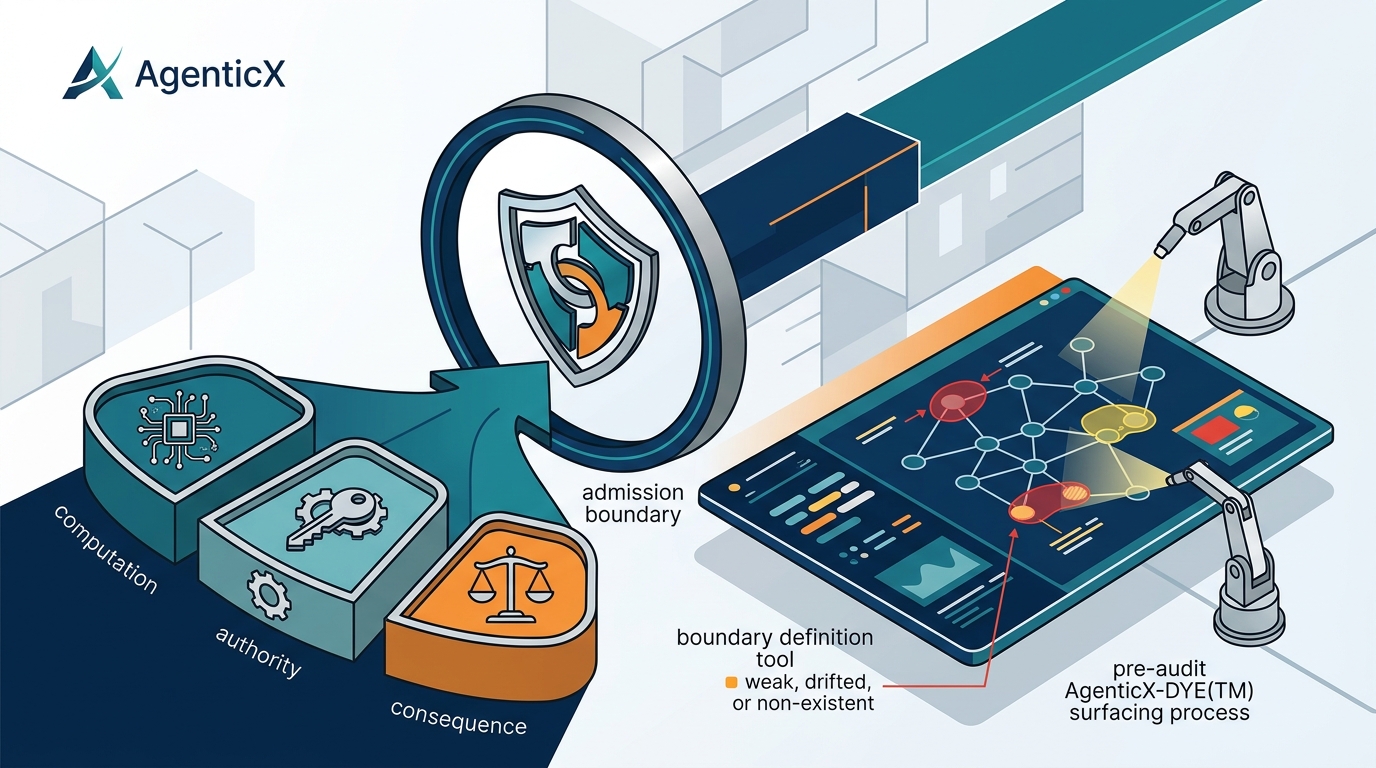
The Three Planes Architecture
VPS separates system operations into three distinct planes to ensure clarity and safety. This architecture is the core of the VPS approach. By isolating these planes, partners can identify which specific layer is causing risk in their current infrastructure.
Plane A: Proposal
Plane A is untrusted. Models, planners, tools, and people propose actions here. It holds no authority over production state or a plant. The risk in this plane is the assumption that a fluent explanation or high confidence score equates to safety. VPS tools help partners define what is allowed to be proposed in the first place.
Plane B: Admission
Plane B is the admission boundary. It performs a small, deterministic check of the attempt and its predicted effect under a fixed policy. This is where the risk identification happens. If the check fails, the action is refused. The admission logic is the critical control point that prevents unauthorized or unsafe transitions.
Plane C: Execution
Plane C is minimal. It carries out only what Plane B authorized and records the outcome. The risk here is limited to the execution of a verified action. By keeping this plane minimal, VPS ensures that the complexity and potential for error are contained within the admission boundary.
Admission Criteria and Evidence
Admission requires five conditions to hold together. These criteria are the specific risks that VPS tools help partners identify and mitigate. If any one of these is missing, the action is refused. Understanding these criteria is essential for any partner preparing for a pilot.
- Independent evidence: Evidence must not be produced by the proposer. This prevents self-attestation risks.
- Bounded, single-use authority: Authority is scoped to the predicted effect. This prevents privilege escalation.
- Verified workload identity: A separate human sponsor is required. This ensures accountability.
- State and sequence continuity: The system must maintain a consistent state. This prevents race conditions and replay attacks.
- Declared constraints satisfied: All pre-defined limits must be met. This ensures the action stays within safe parameters.
Commit also requires a durable decision record before any effect. Rejected attempts are recorded too. This comprehensive logging allows partners to audit not just what happened, but what was attempted and why it was refused.
Pre-Audit Reality Checks
Before engaging in a full pilot, VPS offers an MVP for design partners and clients for pre-audit reality checks. This service allows partners to test their systems against the VPS boundary definition tools without the commitment of a full deployment. The goal is to identify gaps in evidence, authority, and identity verification early in the process.
A single incident of agentic actions can cost significant amounts in fees and lawsuits. By conducting a pre-audit reality check, partners can identify where their boundaries are weak. This proactive approach helps in preparing for outside tests or audits. VPS is not a certifier, but it produces evidence that helps teams understand their current state of verifiable authority.
Pilot Structure and Collaboration
VPS works with partners through three main models: design partners, research partners, and SBIR/STTR teams. The design partner model is a four-week, fixed-fee pilot on one of your systems. It closes with a letter of intent if the criteria agreed in week one are met. This structure ensures that both parties have clear expectations and measurable outcomes. according to 3 Identify Potential
Research partners collaborate on open problems from the paper's evidence program. This is suitable for university groups in formal methods, runtime verification, and AI security. VPS is also preparing an NSF SBIR/STTR Phase I proposal and is forming a team with a university research partner. These collaborations help advance the theoretical foundations of verifiable authority. according to 3 Identify Potential
Comparison of Risk Identification Approaches
| Approach | Risk Identification Method | Limitations | VPS Solution |
|---|---|---|---|
| Traditional Unit Testing | Verifies code logic in isolation | Does not verify authority or consequence | Admission boundary checks predicted effects |
| Safety Filters | Blocks known bad patterns | Reactive, not proactive; misses novel risks | Proactive boundary definition via DARKc |
| Runtime Telemetry | Monitors system state after the fact | Lagging; cannot prevent the action | Pre-execution admission check |
| Model Confidence | Uses probability scores | Confidence is not permission | Independent evidence required for admission |
Key Takeaways
- Verifiable Proof Systems separates computation, authority, and consequence at one admission boundary.
- Boundary definition tools like AgenticX-DYE(TM) surface weak or drifted system limits.
- Admission requires five conditions: independent evidence, bounded authority, verified identity, state continuity, and satisfied constraints.
- Pre-audit reality checks help partners identify risks before committing to a full pilot.
- The three planes architecture (Proposal, Admission, Execution) isolates risk to the admission boundary.
- VPS is a research initiative, not a certifier; it produces evidence for teams preparing for audits.
- Design partner pilots are four-week, fixed-fee engagements that close with a letter of intent if criteria are met.
- Every decision at the boundary is recorded, including refusals, providing a complete audit trail.
Frequently Asked Questions
What is verifiable authority?
Verifiable authority is the infrastructure that ensures a proposed action either becomes a consequence or is refused based on independent evidence, bounded authority, and verified identity.
How does VPS help identify risks before a pilot?
VPS uses boundary definition tools written in DARKc to surface points where system boundaries are weak, drifted, or non-existent. This allows partners to see potential failure points before live deployment.
What is the difference between a proposal and permission?
A proposal is a candidate action generated by a model or planner. Permission is bounded authority over a named object under explicit limits. A good proposal does not create permission; it must be admitted through a deterministic check.
Is VPS a certification body?
No, VPS is not a certifier or an accredited auditor. It is a research initiative that produces evidence to help teams prepare for outside tests or audits. It is not affiliated with AIUC.
What is the cost of a design partner pilot?
The design partner pilot is a four-week, fixed-fee engagement. The specific fee is agreed upon during the initial discussion. It closes with a letter of intent if the criteria agreed in week one are met.
What is DARKc?
DARKc is a formally verified fail-closed compiler and syntax used by VPS to define system boundaries. It ensures that if a check cannot be completed, the action is refused.
Can VPS prevent all unauthorized actions?
VPS finds and documents gaps in authority and evidence. It records each decision, including refusals. It does not guarantee zero risk, but it makes changes detectable and ensures that no action occurs without verified authority.
Conclusion
Identifying risks before engaging in a pilot is critical for any organization deploying autonomous systems. Verifiable Proof Systems provides the tools and framework to separate computation from authority, ensuring that only verified actions proceed to execution. By using boundary definition tools and the three planes architecture, partners can gain a clear view of their system's limits and evidence gaps. To plan your visit or discuss a design-partner pilot, .