%3B%20display%3A%20block%3B%22%20width%3D%2252%22%20height%3D%2229.58971492453885%22%3E%3Cpath%20d%3D%22M68.0%20-638.0H17.0V-698.0H293.0V-638.0H210.0L305.0%20-338.0L372.0%20-111.0H377.0L444.0%20-338.0L539.0%20-638.0H456.0V-698.0H667.0V-638.0H616.0L403.0%200.0H281.0Z%20M675.0%20140.0H739.0V-431.0L675.0%20-444.0V-494.0L870.0%20-534.0V-444.0H875.0Q890.0%20-480.0%20925.5%20-507.0Q961.0%20-534.0%201017.0%20-534.0Q1065.0%20-534.0%201103.5%20-515.0Q1142.0%20-496.0%201169.5%20-460.5Q1197.0%20-425.0%201211.5%20-374.5Q1226.0%20-324.0%201226.0%20-261.0Q1226.0%20-198.0%201211.5%20-147.5Q1197.0%20-97.0%201169.5%20-61.5Q1142.0%20-26.0%201103.5%20-7.0Q1065.0%2012.0%201017.0%2012.0Q960.0%2012.0%20925.0%20-15.0Q890.0%20-42.0%20875.0%20-77.0H870.0V140.0H954.0V200.0H675.0ZM974.0%20-70.0Q1024.0%20-70.0%201055.0%20-104.0Q1086.0%20-138.0%201086.0%20-200.0V-322.0Q1086.0%20-384.0%201055.0%20-418.0Q1024.0%20-452.0%20974.0%20-452.0Q932.0%20-452.0%20901.0%20-426.5Q870.0%20-401.0%20870.0%20-357.0V-165.0Q870.0%20-121.0%20901.0%20-95.5Q932.0%20-70.0%20974.0%20-70.0Z%20M1489.0%2012.0Q1436.0%2012.0%201405.0%20-8.0Q1374.0%20-28.0%201366.0%20-53.0H1362.0V0.0H1276.0V-156.0H1362.0V-138.0Q1362.0%20-98.0%201387.0%20-76.0Q1412.0%20-54.0%201468.0%20-54.0Q1568.0%20-54.0%201568.0%20-122.0Q1568.0%20-150.0%201550.0%20-166.5Q1532.0%20-183.0%201494.0%20-193.0L1444.0%20-206.0Q1361.0%20-228.0%201320.5%20-267.5Q1280.0%20-307.0%201280.0%20-375.0Q1280.0%20-451.0%201330.0%20-492.5Q1380.0%20-534.0%201464.0%20-534.0Q1515.0%20-534.0%201544.5%20-515.5Q1574.0%20-497.0%201582.0%20-472.0H1586.0V-522.0H1672.0V-366.0H1586.0V-390.0Q1586.0%20-428.0%201561.0%20-448.0Q1536.0%20-468.0%201482.0%20-468.0Q1396.0%20-468.0%201396.0%20-405.0Q1396.0%20-376.0%201413.5%20-358.0Q1431.0%20-340.0%201473.0%20-330.0L1520.0%20-319.0Q1602.0%20-299.0%201644.0%20-262.0Q1686.0%20-225.0%201686.0%20-152.0Q1686.0%20-75.0%201632.5%20-31.5Q1579.0%2012.0%201489.0%2012.0Z%22%3E%3C%2Fpath%3E%3C%2Fsvg%3E)

Verifiable Proof Systems helps partners identify potential risks before engaging in a pilot by separating computation, authority, and consequence at a single admission boundary. This guide explains how the framework distinguishes between a proposed action and an actual effect. It covers the specific tools and evidence requirements needed to validate system boundaries before any consequential change occurs.
Boundary Definition Tools
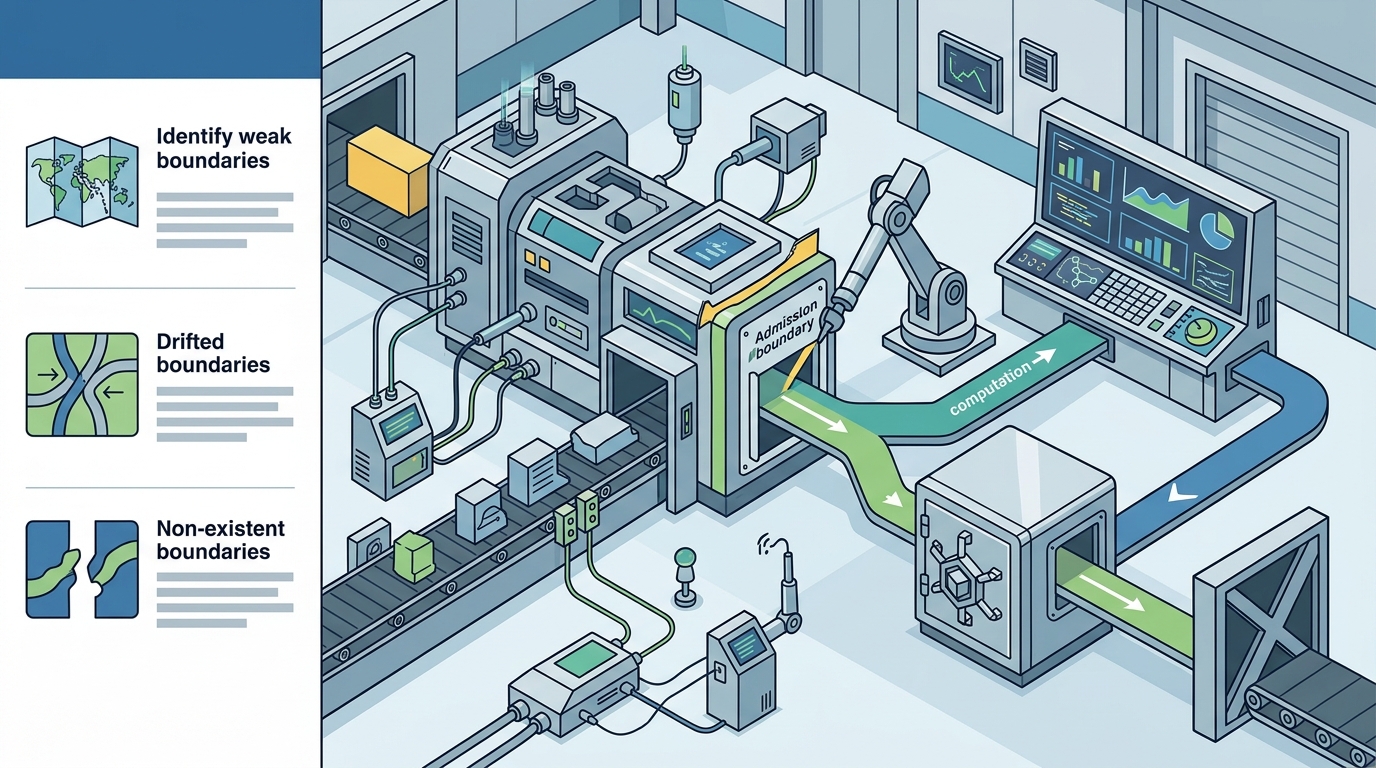
Defining system boundaries is the first step in identifying risk. Verifiable Proof Systems provides custom tools for defining these boundaries. These tools are written in DARKc, a formally verified fail-closed compiler and syntax. The primary tool, AgenticX-DYE(TM), surfaces points where boundaries are weak, drifted, or non-existent. This allows teams to see exactly where a system might fail before a pilot begins.
Defining the Boundary
A system boundary is the limit of a system's authority to act. It defines what the system can and cannot do. By using AgenticX-DYE(TM), partners can map these limits explicitly. This prevents the common error of assuming a system's capabilities based on its output.
Fail-Closed Design
The tools operate on a fail-closed principle. If a boundary check fails, the system refuses the action. This ensures that uncertainty does not lead to execution. The compiler enforces these rules at the syntax level, making the boundary definition part of the code itself.
The Admission Boundary
The core of the Verifiable Proof Systems approach is the admission boundary. This is the point where a proposed action either becomes a consequence or is refused. The framework separates three distinct planes: Proposal, Admission, and Execution. This separation ensures that intelligence can propose actions, but authority must be independently established.
Plane A: Proposal
Plane A is untrusted. Models, planners, tools, and people propose actions here. This plane holds no authority over production state or a plant. A proposal is simply a candidate action. It carries no permission and no effect.
Plane B: Admission
Plane B is the admission boundary. It performs a small, deterministic check of the attempt and its predicted effect. This check happens under a fixed policy. It is the only place where a proposal can gain authority.
Plane C: Execution
Plane C is minimal. It carries out only what Plane B authorized. It records the outcome. This ensures that the execution is strictly bounded by the admission decision.
Evidence Requirements
Admission at the boundary requires five specific conditions to hold together. These conditions ensure that the authority granted is bounded and verifiable. Without all five, the action is refused. This strict requirement helps partners identify gaps in their current systems.
Independent Evidence
The first condition is independent evidence. This evidence must not be produced by the proposer. It provides an external check on the proposed action. This prevents the proposer from validating its own work.
Bounded Authority
The second condition is bounded, single-use authority. This authority is scoped to the predicted effect. It cannot be reused for other actions. This limits the blast radius of any potential error.
Verified Identity and Sponsor
The third condition is a verified workload identity and a separate human sponsor. The identity ensures the workload is known. The sponsor provides human accountability. This separates the machine's action from human responsibility.
Pilot Structure and Baselines
Verifiable Proof Systems offers a four-week, fixed-fee pilot for design partners. This pilot runs on one of the partner's systems. It closes with a letter of intent if the criteria agreed in week one are met. This structure allows partners to test the framework in a controlled environment.
Week One Baseline
ROI Measurement
ROI is measured with each partner against the baseline agreed in week one. This ensures that the value of the pilot is tied to specific, pre-agreed outcomes. It avoids vague claims of improvement. The pilot focuses on identifying risks, not on guaranteeing outcomes.
Comparison of Assurance Mechanisms
The following table compares common assurance mechanisms with the Verifiable Proof Systems approach. It highlights why traditional methods are often insufficient for agentic systems.
| Mechanism | What It Provides | Limitation for Agentic Systems |
|---|---|---|
| Model Confidence | A score indicating the model's certainty. | Confidence is not permission. It does not verify the effect. |
| Passing Unit Tests | Verification of specific code paths. | Tests are static. They do not verify runtime state or sequence continuity. |
| Signed Artifacts | Proof of origin for a file or message. | Signature does not verify the action's effect or authority. |
| Lagging Telemetry | Post-hoc data on system behavior. | Too late to prevent an action. It records, it does not admit. |
| Verifiable Proof Systems | Admission based on five independent conditions. | Requires independent evidence and bounded authority at the boundary. |
Key Takeaways
- Verifiable Proof Systems separates computation, authority, and consequence at one admission boundary.
- AgenticX-DYE(TM) surfaces weak, drifted, or non-existent boundaries in a system.
- Admission requires five conditions: independent evidence, bounded authority, verified identity, state continuity, and declared constraints.
- The pilot is a four-week, fixed-fee assessment that closes with a letter of intent if criteria are met.
- ROI is measured against a baseline agreed in week one, ensuring specific, pre-agreed outcomes.
- Traditional mechanisms like model confidence and passing tests are testimony about a proposal, not permission for an effect.
- The framework is a published conceptual framework (DOI 10.5281/zenodo.23092344) with formal models in development.
Frequently Asked Questions
What is the admission boundary?
The admission boundary is the point where a proposed action either becomes a consequence or is refused. It is the only place where a proposal can gain authority.
How does AgenticX-DYE(TM) work?
AgenticX-DYE(TM) is a tool written in DARKc. It surfaces points where system boundaries are weak, drifted, or non-existent. It helps teams see where a system might fail before a pilot begins.
What are the five conditions for admission?
The five conditions are: independent evidence, bounded single-use authority, verified workload identity and human sponsor, state and sequence continuity, and declared constraints satisfied.
How long is the pilot?
The pilot is four weeks long. It is a fixed-fee assessment on one of the partner's systems. It closes with a letter of intent if the criteria agreed in week one are met.
Is Verifiable Proof Systems a certified product?
No. Verifiable Proof Systems is a research initiative. It is not a certifier or an accredited auditor. It produces evidence for specific requirements but does not issue certifications.
What is the difference between a proposal and an effect?
A proposal is a candidate action generated by a model or planner. It carries no permission and no effect. An effect is a change to authoritative state or a physical actuator. Only the admission boundary can turn a proposal into an effect.
How is ROI measured in the pilot?
ROI is measured with each partner against a baseline agreed in week one. This ensures that the value of the pilot is tied to specific, pre-agreed outcomes.
What is DARKc?
DARKc is a formally verified fail-closed compiler and syntax. It is used to write the custom tools for defining system boundaries. It enforces fail-closed rules at the syntax level.
Conclusion
Identifying risks before a pilot requires a clear separation between proposal and effect. Verifiable Proof Systems provides the tools and framework to make this separation explicit. By using AgenticX-DYE(TM) and the admission boundary, partners can see where their systems are weak. To discuss a design-partner pilot, .