%3B%20display%3A%20block%3B%22%20width%3D%2252%22%20height%3D%2229.58971492453885%22%3E%3Cpath%20d%3D%22M68.0%20-638.0H17.0V-698.0H293.0V-638.0H210.0L305.0%20-338.0L372.0%20-111.0H377.0L444.0%20-338.0L539.0%20-638.0H456.0V-698.0H667.0V-638.0H616.0L403.0%200.0H281.0Z%20M675.0%20140.0H739.0V-431.0L675.0%20-444.0V-494.0L870.0%20-534.0V-444.0H875.0Q890.0%20-480.0%20925.5%20-507.0Q961.0%20-534.0%201017.0%20-534.0Q1065.0%20-534.0%201103.5%20-515.0Q1142.0%20-496.0%201169.5%20-460.5Q1197.0%20-425.0%201211.5%20-374.5Q1226.0%20-324.0%201226.0%20-261.0Q1226.0%20-198.0%201211.5%20-147.5Q1197.0%20-97.0%201169.5%20-61.5Q1142.0%20-26.0%201103.5%20-7.0Q1065.0%2012.0%201017.0%2012.0Q960.0%2012.0%20925.0%20-15.0Q890.0%20-42.0%20875.0%20-77.0H870.0V140.0H954.0V200.0H675.0ZM974.0%20-70.0Q1024.0%20-70.0%201055.0%20-104.0Q1086.0%20-138.0%201086.0%20-200.0V-322.0Q1086.0%20-384.0%201055.0%20-418.0Q1024.0%20-452.0%20974.0%20-452.0Q932.0%20-452.0%20901.0%20-426.5Q870.0%20-401.0%20870.0%20-357.0V-165.0Q870.0%20-121.0%20901.0%20-95.5Q932.0%20-70.0%20974.0%20-70.0Z%20M1489.0%2012.0Q1436.0%2012.0%201405.0%20-8.0Q1374.0%20-28.0%201366.0%20-53.0H1362.0V0.0H1276.0V-156.0H1362.0V-138.0Q1362.0%20-98.0%201387.0%20-76.0Q1412.0%20-54.0%201468.0%20-54.0Q1568.0%20-54.0%201568.0%20-122.0Q1568.0%20-150.0%201550.0%20-166.5Q1532.0%20-183.0%201494.0%20-193.0L1444.0%20-206.0Q1361.0%20-228.0%201320.5%20-267.5Q1280.0%20-307.0%201280.0%20-375.0Q1280.0%20-451.0%201330.0%20-492.5Q1380.0%20-534.0%201464.0%20-534.0Q1515.0%20-534.0%201544.5%20-515.5Q1574.0%20-497.0%201582.0%20-472.0H1586.0V-522.0H1672.0V-366.0H1586.0V-390.0Q1586.0%20-428.0%201561.0%20-448.0Q1536.0%20-468.0%201482.0%20-468.0Q1396.0%20-468.0%201396.0%20-405.0Q1396.0%20-376.0%201413.5%20-358.0Q1431.0%20-340.0%201473.0%20-330.0L1520.0%20-319.0Q1602.0%20-299.0%201644.0%20-262.0Q1686.0%20-225.0%201686.0%20-152.0Q1686.0%20-75.0%201632.5%20-31.5Q1579.0%2012.0%201489.0%2012.0Z%22%3E%3C%2Fpath%3E%3C%2Fsvg%3E)

Verifiable Authority: The 2026 Guide to NDA-Backed B2B Proof Systems
Cryptographic Attestation Layers
Cryptographic attestation is the process of verifying the integrity and origin of a digital artifact or action. In the context of autonomous infrastructure, attestation moves beyond simple signature checks to include the state of the system at the time of the action. Verifiable Proof Systems treats outputs as testimony, not proof. A model's confidence score or a passing unit test is testimony about a proposal. It does not admit the transition to a consequential action.
Testimony vs. Proof
Many current systems treat a signed artifact from the proposing system as permission. VPS argues that a signed artifact is merely evidence that a proposal was made. It is not evidence that the action is authorized or safe. The system requires independent evidence that was not produced by the proposer. This separation ensures that the authority to act is established independently of the intelligence that proposed the action.
Role of the Claim Ledger
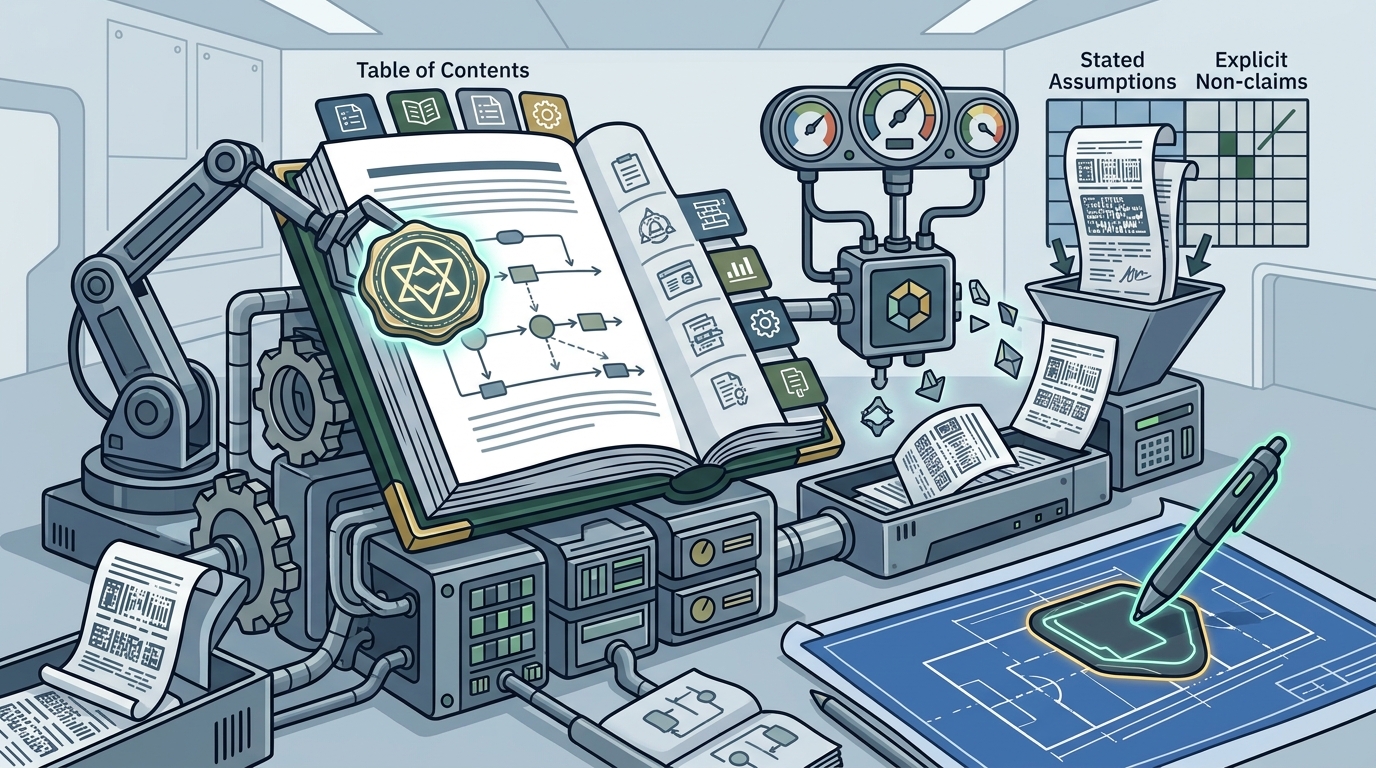
VPS maintains a public claim ledger containing 115 entries. These entries document stated assumptions, explicit non-claims, and their respective falsifiers and statuses. This ledger serves as a cryptographic record of what the system claims and what it does not claim. It provides a transparent basis for third-party verification and audit.
The Three-Plane Architecture
The core of the VPS approach is a boundary that separates three distinct planes: Proposal, Admission, and Execution. This architecture ensures that no action occurs without independent authority. The planes are designed to be minimal and deterministic, reducing the attack surface and the complexity of the verification process.
Plane A: Proposal
Plane A is the untrusted zone. Models, planners, tools, and people propose actions here. This plane holds no authority over production state or physical actuators. A proposal is a candidate action. It is cheap to produce but carries no permission and no effect. The goal of Plane A is to generate high-quality candidates for review.
Plane B: Admission
Plane B is the admission boundary. It performs a small, deterministic check of the attempt and its predicted effect under a fixed policy. This is where authority is established. The check is not a complex AI inference. It is a formal verification step that ensures the action meets all required conditions before it can proceed to execution.
Plane C: Execution
Plane C is minimal. It carries out only what Plane B authorized and records the outcome. The execution plane does not make decisions. It simply applies the authorized change to the authoritative state or physical actuator. This separation ensures that the execution layer remains simple and auditable.
Mutual NDA Partnerships as a Foundation
Mutual Non-Disclosure Agreements (NDAs) are the legal and operational foundation for VPS's B2B collaboration model. In a research-driven initiative, sharing detailed system designs and boundary definitions requires a high level of trust. Mutual NDAs protect the intellectual property of both parties while allowing for the deep technical exchange necessary to build verifiable authority infrastructure.
Why NDAs Matter in Autonomous Infrastructure
Autonomous systems often involve proprietary algorithms and sensitive operational data. Without a mutual NDA, partners are reluctant to share the specific boundary definitions and constraint sets that are necessary for verification. VPS uses these partnerships to co-develop and test the admission boundary logic. The NDA ensures that the shared designs remain confidential while the research progresses.
From NDA to Pilot
The mutual NDA is the first step in a structured collaboration. It leads to a design-partner pilot, which is a four-week, fixed-fee engagement. This pilot allows VPS and the partner to test the admission boundary on one of the partner's systems. The NDA protects the partner's system details during this intensive testing phase.
The Admission Boundary and Five Conditions
The admission boundary is the critical checkpoint where a proposed action either becomes a consequence or is refused. Admission requires five specific conditions to hold together. These conditions ensure that the action is authorized, verified, and constrained. The boundary is designed to be fail-closed, meaning that if any condition is not met, the action is refused.
The Five Assurance Conditions
- Independent Evidence: Evidence that was not produced by the proposer.
- Bounded Authority: Single-use authority scoped to the predicted effect.
- Verified Identity: A verified workload identity and a separate human sponsor.
- State Continuity: State and sequence continuity to prevent replay or drift.
- Declared Constraints: All declared constraints must be satisfied.
These conditions are checked deterministically in Plane B. The result of the check is a durable decision record. This record is created before any effect occurs. Rejected attempts are recorded too, providing a complete audit trail of all decisions made at the boundary.
Design Partner Pilots and Research Collaboration
VPS offers three ways to work with the initiative: design partners, research partners, and SBIR/STTR teams. Each path is designed to advance the research and implementation of verifiable authority systems. The primary offering for B2B collaboration is the design-partner pilot.
Design Partner Pilot
The design-partner pilot is a four-week, fixed-fee engagement on one of the partner's systems. The pilot closes with a letter of intent if the criteria agreed in week one are met. This structure provides a clear, low-risk way for organizations to test the VPS admission boundary on their own infrastructure. The pilot focuses on defining the system's boundaries and identifying where they are weak, drifted, or non-existent.
Research and SBIR/STTR Collaboration
VPS is also forming a team with a university research partner for an NSF SBIR/STTR Phase I proposal. This collaboration focuses on open problems from the paper's evidence program, including formal methods, runtime verification, and AI security. Research partners can engage with the open problems defined in the CEAK-PRO 1.0 paper.
| Collaboration Model | Duration | Focus | Outcome |
|---|---|---|---|
| Design Partner Pilot | 4 Weeks | Testing admission boundary on partner system | Letter of Intent if criteria met |
| Research Partner | Ongoing | Formal methods and runtime verification | Companion papers and implementation results |
| SBIR/STTR Team | Phase I | NSF proposal and university collaboration | Funded research and development |
Key Takeaways
- The system separates computation, authority, and consequence at a single admission boundary.
- Admission requires five conditions: independent evidence, bounded authority, verified identity, state continuity, and declared constraints.
- The three-plane architecture (Proposal, Admission, Execution) ensures that no action occurs without independent authority.
- The design-partner pilot is a four-week, fixed-fee engagement that tests the admission boundary on a partner's system.
- VPS maintains a public claim ledger with 115 entries documenting assumptions and non-claims.
- The CEAK-PRO 1.0 paper is a conceptual working paper that reports no model-checking or implementation results yet.
- ROI is measured with each partner against a baseline agreed in week one of the pilot.
Frequently Asked Questions
What is the core problem VPS is solving?
Software now proposes consequential actions faster than anyone can review them. A proposal is not permission, and permission is not the effect. VPS is building the boundary where a proposed action either becomes a consequence or is refused.
How does the mutual NDA partnership work?
Mutual NDAs protect the intellectual property of both parties while allowing for the deep technical exchange necessary to build verifiable authority infrastructure. It is the first step in a structured collaboration that leads to a design-partner pilot.
What are the five assurance conditions?
The five conditions are: independent evidence, bounded single-use authority, a verified workload identity and separate human sponsor, state and sequence continuity, and declared constraints satisfied. All five must hold together for admission.
Is the system formally verified?
CEAK-PRO 1.0 is a conceptual working paper. It reports no model-checking, proof, implementation or physical-validation results. Formal models and an implementation are in development for a companion paper.
What is the cost of the design-partner pilot?
The design-partner pilot is a four-week, fixed-fee engagement. The specific fee is agreed upon during the initial discussion. ROI is measured against a baseline agreed in week one.
Can VPS guarantee that the system is secure?
VPS does not make absolute security claims. The system finds and documents gaps, records each decision including refusals, and makes changes detectable. It shows where the evidence stops. It is not a guarantee of zero risk.
Conclusion
Verifiable Proof Systems is at the forefront of developing infrastructure for verifiable authority in the age of autonomous software. By using mutual NDA partnerships as the foundation for B2B collaboration, VPS enables deep technical exchange while protecting intellectual property. The three-plane architecture and the five assurance conditions provide a robust framework for ensuring that consequential actions are authorized and verified. For organizations looking to prepare for the future of autonomous infrastructure, the design-partner pilot offers a clear, low-risk path to test these concepts on their own systems. To discuss a design-partner pilot or research collaboration, .