%3B%20display%3A%20block%3B%22%20width%3D%2252%22%20height%3D%2229.58971492453885%22%3E%3Cpath%20d%3D%22M68.0%20-638.0H17.0V-698.0H293.0V-638.0H210.0L305.0%20-338.0L372.0%20-111.0H377.0L444.0%20-338.0L539.0%20-638.0H456.0V-698.0H667.0V-638.0H616.0L403.0%200.0H281.0Z%20M675.0%20140.0H739.0V-431.0L675.0%20-444.0V-494.0L870.0%20-534.0V-444.0H875.0Q890.0%20-480.0%20925.5%20-507.0Q961.0%20-534.0%201017.0%20-534.0Q1065.0%20-534.0%201103.5%20-515.0Q1142.0%20-496.0%201169.5%20-460.5Q1197.0%20-425.0%201211.5%20-374.5Q1226.0%20-324.0%201226.0%20-261.0Q1226.0%20-198.0%201211.5%20-147.5Q1197.0%20-97.0%201169.5%20-61.5Q1142.0%20-26.0%201103.5%20-7.0Q1065.0%2012.0%201017.0%2012.0Q960.0%2012.0%20925.0%20-15.0Q890.0%20-42.0%20875.0%20-77.0H870.0V140.0H954.0V200.0H675.0ZM974.0%20-70.0Q1024.0%20-70.0%201055.0%20-104.0Q1086.0%20-138.0%201086.0%20-200.0V-322.0Q1086.0%20-384.0%201055.0%20-418.0Q1024.0%20-452.0%20974.0%20-452.0Q932.0%20-452.0%20901.0%20-426.5Q870.0%20-401.0%20870.0%20-357.0V-165.0Q870.0%20-121.0%20901.0%20-95.5Q932.0%20-70.0%20974.0%20-70.0Z%20M1489.0%2012.0Q1436.0%2012.0%201405.0%20-8.0Q1374.0%20-28.0%201366.0%20-53.0H1362.0V0.0H1276.0V-156.0H1362.0V-138.0Q1362.0%20-98.0%201387.0%20-76.0Q1412.0%20-54.0%201468.0%20-54.0Q1568.0%20-54.0%201568.0%20-122.0Q1568.0%20-150.0%201550.0%20-166.5Q1532.0%20-183.0%201494.0%20-193.0L1444.0%20-206.0Q1361.0%20-228.0%201320.5%20-267.5Q1280.0%20-307.0%201280.0%20-375.0Q1280.0%20-451.0%201330.0%20-492.5Q1380.0%20-534.0%201464.0%20-534.0Q1515.0%20-534.0%201544.5%20-515.5Q1574.0%20-497.0%201582.0%20-472.0H1586.0V-522.0H1672.0V-366.0H1586.0V-390.0Q1586.0%20-428.0%201561.0%20-448.0Q1536.0%20-468.0%201482.0%20-468.0Q1396.0%20-468.0%201396.0%20-405.0Q1396.0%20-376.0%201413.5%20-358.0Q1431.0%20-340.0%201473.0%20-330.0L1520.0%20-319.0Q1602.0%20-299.0%201644.0%20-262.0Q1686.0%20-225.0%201686.0%20-152.0Q1686.0%20-75.0%201632.5%20-31.5Q1579.0%2012.0%201489.0%2012.0Z%22%3E%3C%2Fpath%3E%3C%2Fsvg%3E)

Verifiable Authority: The 2026 Guide to NDA-Based B2B Proof Systems
Cryptographic Attestation Layers
Cryptographic attestation is a method of verifying the integrity of a system state using digital signatures. In the context of verifiable authority, attestation provides independent evidence that a proposed action meets specific constraints. Verifiable Proof Systems relies on this evidence to bridge the gap between a model's proposal and a real-world consequence. according to Office of Integrated
Independent Evidence Requirements
Admission in the VPS framework requires independent evidence that was not produced by the proposing system. This prevents a model from generating its own permission. The evidence must be verifiable and bounded to the predicted effect of the action.
State and Sequence Continuity
State continuity is the property that ensures a system's history is unbroken and verifiable. By tracking sequence numbers and state hashes, the system can detect if an action is out of order or if the state has drifted. This layer ensures that the authority granted is valid for the current context.
Declared Constraints
Declared constraints are the explicit limits placed on an action, such as maximum value or allowed time windows. The admission boundary checks these constraints against the current state. If a constraint is violated, the action is refused and the refusal is recorded.
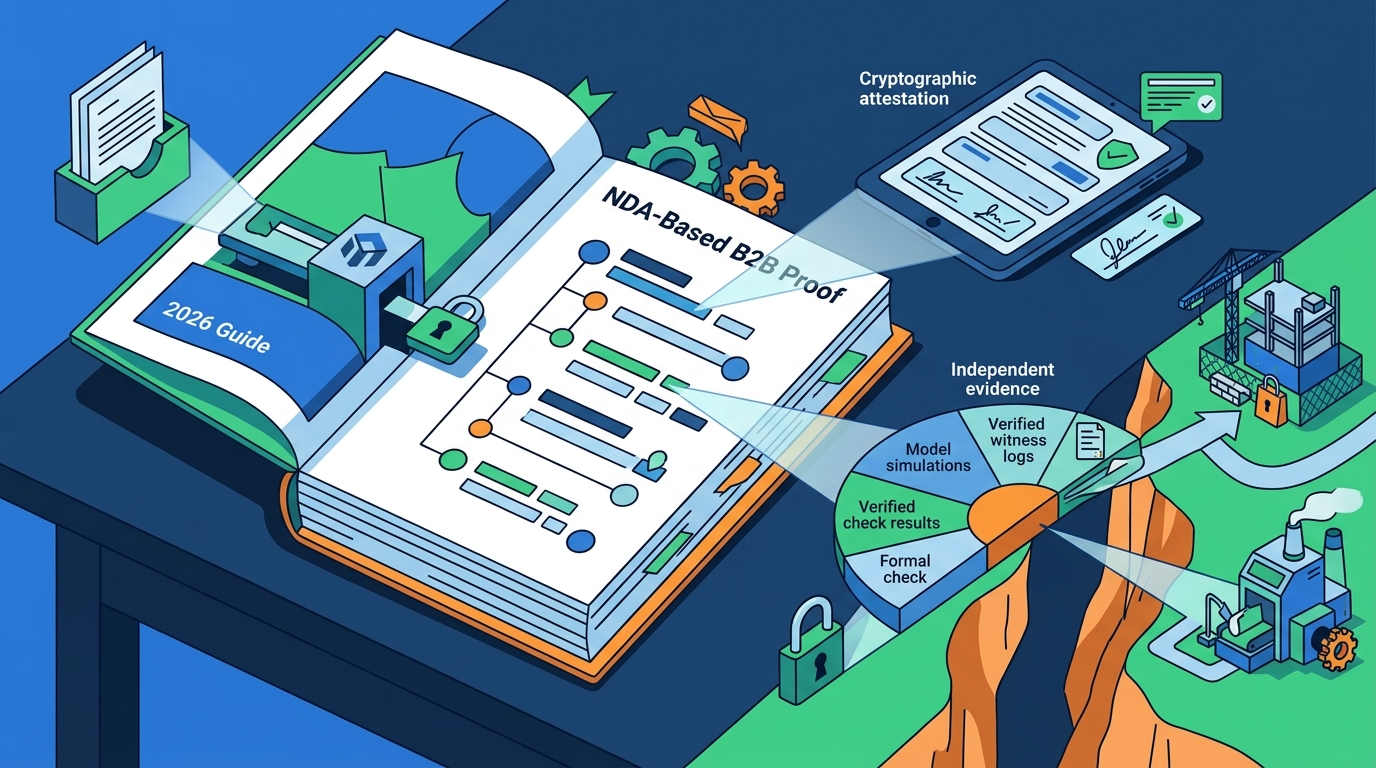
The Mutual NDA Foundation
Securing the Design Phase
During the design phase, partners share system architectures and boundary definitions under NDA. This allows VPS to analyze the client's specific systems without exposing them to public risk. The NDA ensures that the insights gained during the pilot remain confidential to the two parties.
From Confidentiality to Verification
While an NDA protects information, it does not verify actions. VPS bridges this gap by applying its proof system to the confidential designs. The result is a verified model of the client's authority boundaries, which can then be used to build the admission infrastructure.
The Admission Boundary
The admission boundary is a deterministic checkpoint that decides whether a proposed action becomes a consequence. It sits between the untrusted proposal plane and the minimal execution plane. This boundary is the core of the Verifiable Proof Systems architecture.
Three Planes of Operation
The system operates on three distinct planes. Plane A is the Proposal plane, where models and humans generate candidate actions. Plane B is the Admission plane, where the deterministic check occurs. Plane C is the Execution plane, which carries out only what Plane B authorized.
The Five Assurance Conditions
For an action to be admitted, five conditions must hold together. These are independent evidence, bounded single-use authority, verified workload identity, state continuity, and satisfied declared constraints. If any one condition fails, the action is refused. This all-or-nothing approach ensures that no partial authority is granted.
Recording Refusals
Every decision at the boundary is recorded, including refusals. This creates a durable decision record that serves as an audit trail. By logging refusals, the system provides evidence of what was attempted and why it was blocked, which is critical for post-incident analysis.
Agentic Risk and Cost
Agentic risk is the potential for financial or operational loss caused by autonomous software actions. As models propose tool calls, database writes, and payments, the cost of a single error can be significant. Verifiable Proof Systems addresses this by ensuring that no action occurs without independent authority.
The Cost of a Single Incident
Boundary Drift and Weakness
Boundary drift is the gradual weakening of system constraints over time. VPS uses its AgenticX-DYE(TM) tool to surface points where boundaries are weak, drifted, or non-existent. This tool is written in DARKc, a formally verified fail-closed compiler and syntax, ensuring that the analysis itself is reliable.
Pilot Structure and ROI
The design-partner pilot is a four-week, fixed-fee engagement that applies the VPS framework to one of the client's systems. The goal is to close with a letter of intent if the criteria agreed in week one are met. This structure provides a low-risk way to evaluate the framework.
Week One: Baseline and Criteria
In week one, VPS and the partner agree on the specific criteria for success. This baseline is used to measure the effectiveness of the pilot. By defining the goals upfront, both parties have a clear understanding of what constitutes a successful outcome.
Measuring ROI
ROI is measured with each partner against the baseline agreed in week one. This approach avoids generic claims about savings or risk reduction. Instead, it provides a concrete, partner-specific metric that reflects the actual value of the verification infrastructure.
Key Takeaways
- Verifiable Proof Systems uses mutual NDAs to secure the design phase of B2B collaboration.
- The admission boundary requires five assurance conditions to hold together for any action to proceed.
- Cryptographic attestation provides the independent evidence needed to verify proposed actions.
- The AgenticX-DYE(TM) tool identifies weak or drifted boundaries using the DARKc syntax.
- The four-week pilot structure allows partners to measure ROI against a specific baseline.
- Every decision, including refusals, is recorded in a durable decision record for audit purposes.
Frequently Asked Questions
What is the role of a mutual NDA in the VPS framework?
The mutual NDA protects the confidential information shared during the design phase. It allows VPS to analyze the client's systems without exposing them to public risk, forming the trust foundation for the collaboration.
How does the admission boundary prevent unauthorized actions?
The admission boundary checks five assurance conditions before allowing an action to proceed. If any condition fails, the action is refused. This ensures that no action occurs without independent, bounded authority.
What is DARKc and how is it used?
DARKc is a formally verified fail-closed compiler and syntax used by VPS. It is used to write custom tools, such as AgenticX-DYE(TM), which surface points where system boundaries are weak or non-existent.
How is ROI measured in a VPS pilot?
ROI is measured against a baseline agreed upon in week one of the pilot. This partner-specific baseline ensures that the value of the verification infrastructure is assessed in the context of the client's specific systems.
Does VPS provide legal or compliance advice?
No, VPS is not a law firm or a regulator. The framework produces evidence for audit and compliance requirements, but it does not provide legal advice or guarantee compliance with specific regulations.
What happens if an action is refused at the boundary?
If an action is refused, the refusal is recorded in the durable decision record. This record serves as an audit trail, documenting what was attempted and why it was blocked, which is essential for post-incident analysis.
Is the VPS framework formally verified?
The CEAK-PRO 1.0 paper is a conceptual working paper. It reports no model-checking, proof, or implementation results. Formal models and an implementation are in development for a companion paper.
Conclusion
Verifiable Proof Systems provides a robust framework for B2B collaboration based on mutual NDAs and verifiable authority. By separating computation, authority, and consequence, VPS helps organizations manage the risks of agentic systems. To explore how this framework can be applied to your systems, to discuss a design-partner pilot. according to What Does It