%3B%20display%3A%20block%3B%22%20width%3D%2252%22%20height%3D%2229.58971492453885%22%3E%3Cpath%20d%3D%22M68.0%20-638.0H17.0V-698.0H293.0V-638.0H210.0L305.0%20-338.0L372.0%20-111.0H377.0L444.0%20-338.0L539.0%20-638.0H456.0V-698.0H667.0V-638.0H616.0L403.0%200.0H281.0Z%20M675.0%20140.0H739.0V-431.0L675.0%20-444.0V-494.0L870.0%20-534.0V-444.0H875.0Q890.0%20-480.0%20925.5%20-507.0Q961.0%20-534.0%201017.0%20-534.0Q1065.0%20-534.0%201103.5%20-515.0Q1142.0%20-496.0%201169.5%20-460.5Q1197.0%20-425.0%201211.5%20-374.5Q1226.0%20-324.0%201226.0%20-261.0Q1226.0%20-198.0%201211.5%20-147.5Q1197.0%20-97.0%201169.5%20-61.5Q1142.0%20-26.0%201103.5%20-7.0Q1065.0%2012.0%201017.0%2012.0Q960.0%2012.0%20925.0%20-15.0Q890.0%20-42.0%20875.0%20-77.0H870.0V140.0H954.0V200.0H675.0ZM974.0%20-70.0Q1024.0%20-70.0%201055.0%20-104.0Q1086.0%20-138.0%201086.0%20-200.0V-322.0Q1086.0%20-384.0%201055.0%20-418.0Q1024.0%20-452.0%20974.0%20-452.0Q932.0%20-452.0%20901.0%20-426.5Q870.0%20-401.0%20870.0%20-357.0V-165.0Q870.0%20-121.0%20901.0%20-95.5Q932.0%20-70.0%20974.0%20-70.0Z%20M1489.0%2012.0Q1436.0%2012.0%201405.0%20-8.0Q1374.0%20-28.0%201366.0%20-53.0H1362.0V0.0H1276.0V-156.0H1362.0V-138.0Q1362.0%20-98.0%201387.0%20-76.0Q1412.0%20-54.0%201468.0%20-54.0Q1568.0%20-54.0%201568.0%20-122.0Q1568.0%20-150.0%201550.0%20-166.5Q1532.0%20-183.0%201494.0%20-193.0L1444.0%20-206.0Q1361.0%20-228.0%201320.5%20-267.5Q1280.0%20-307.0%201280.0%20-375.0Q1280.0%20-451.0%201330.0%20-492.5Q1380.0%20-534.0%201464.0%20-534.0Q1515.0%20-534.0%201544.5%20-515.5Q1574.0%20-497.0%201582.0%20-472.0H1586.0V-522.0H1672.0V-366.0H1586.0V-390.0Q1586.0%20-428.0%201561.0%20-448.0Q1536.0%20-468.0%201482.0%20-468.0Q1396.0%20-468.0%201396.0%20-405.0Q1396.0%20-376.0%201413.5%20-358.0Q1431.0%20-340.0%201473.0%20-330.0L1520.0%20-319.0Q1602.0%20-299.0%201644.0%20-262.0Q1686.0%20-225.0%201686.0%20-152.0Q1686.0%20-75.0%201632.5%20-31.5Q1579.0%2012.0%201489.0%2012.0Z%22%3E%3C%2Fpath%3E%3C%2Fsvg%3E)

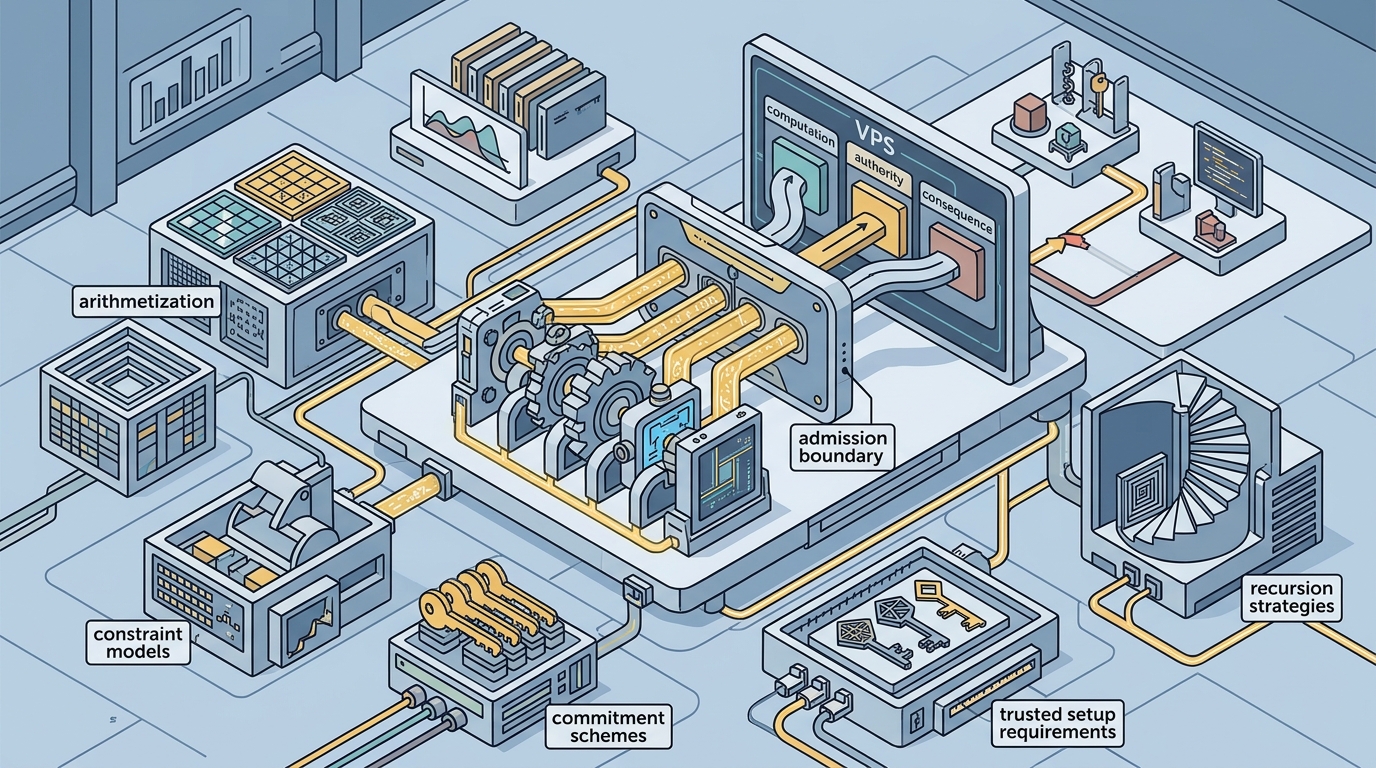
Verifiable Proof Systems (VPS) separates computation, authority, and consequence at a single admission boundary. This approach differs from leading proof systems by requiring five assurance conditions to hold together before any action is admitted. This guide covers proof system arithmetization, constraint models, commitment schemes, trusted setup requirements, and recursion strategies. It explains how VPS designs these components to support verifiable authority in autonomous infrastructure.
Proof System Arithmetization
Proof system arithmetization is the process of translating computational logic into arithmetic constraints that can be verified by a proof system. In traditional systems, this often involves converting Boolean circuits into Rank-1 Constraint Systems (R1CS) or Polynomial Identity Checks (PIC). These methods allow a prover to generate a succinct proof that a computation was performed correctly. However, the arithmetization step itself does not establish authority over the action being proposed. It only verifies that the computation followed the specified rules.
Arithmetization in VPS
Verifiable Proof Systems treats arithmetization as a component of the computation plane, not the admission plane. The computation plane generates candidate actions, which may include tool calls, database writes, or setpoint changes. These actions are cheap to produce but can have expensive consequences. VPS separates this generation step from the admission step. The arithmetization verifies the internal logic of the proposal, but it does not grant permission to execute. This distinction is critical because a passing unit test or a signed artifact from the proposing system is testimony about a proposal, not permission for the transition.
Comparison with Leading Systems
Many leading proof systems focus on the efficiency of the arithmetization layer. They optimize for low proof generation time and small proof sizes. While these metrics are important for scalability, they do not address the authority gap. VPS focuses on the boundary where a proposed action either becomes a consequence or is refused. The arithmetization in VPS is designed to support this boundary by providing independent evidence that the proposal is well-formed. This evidence is then checked against bounded authority and verified identity at the admission plane.
Constraint Models
Constraint models define the rules that a system must follow to operate within its intended boundaries. In autonomous infrastructure, these constraints can include safety limits, operational policies, and legal requirements. A constraint model is a formal specification of the conditions under which an action is permitted. It serves as the policy layer that the admission plane checks against.
Dynamic vs. Static Constraints
Static constraints are fixed rules that do not change over time, such as maximum temperature limits in a physical plant. Dynamic constraints can change based on the state of the system or external conditions. VPS supports both types of constraints in its admission plane. The admission plane performs a small, deterministic check of the attempt and its predicted effect under a fixed policy. This check ensures that the proposed action satisfies all declared constraints before it is admitted for execution.
Constraint Drift and Detection
Constraint drift occurs when the actual behavior of a system deviates from its declared constraints over time. This can happen due to software updates, configuration changes, or environmental factors. VPS uses its AgenticX-DYE(TM) tool to surface points where boundaries are weak, drifted, or non-existent. This tool helps teams identify gaps in their constraint models before they lead to unauthorized actions. By detecting drift early, teams can update their constraint models and maintain the integrity of their admission boundary.
Commitment Schemes
A commitment scheme is a cryptographic primitive that allows a party to commit to a value without revealing it, and later reveal the value in a way that proves it was the original commitment. Commitment schemes are widely used in zero-knowledge proofs and secure multi-party computation. They provide a way to bind a party to a specific action or state without exposing the details until a later stage.
Commitment in the Admission Plane
In VPS, commitment schemes are used to bind the proposer to the specific action they are proposing. The proposer commits to the action and its predicted effect before the admission check. This commitment ensures that the proposer cannot change the action after the admission check has passed. The commitment is part of the durable decision record that is created before any effect is executed. This record includes the commitment, the admission decision, and the outcome of the execution.
Comparison with Other Systems
Other proof systems may use commitment schemes for different purposes, such as hiding the witness in a zero-knowledge proof. VPS uses commitment schemes specifically to support the admission boundary. The commitment ensures that the action being admitted is the same action that was proposed. This prevents a class of attacks where a proposer submits one action for admission but executes a different action. By using commitment schemes in this way, VPS strengthens the link between proposal and consequence.
Trusted Setup Requirements
Trusted setup requirements refer to the initial conditions that must be established before a proof system can operate securely. In many cryptographic systems, a trusted setup involves generating secret parameters that are used to create proofs. If these parameters are compromised, the security of the system is compromised. Trusted setups are a common source of criticism for proof systems because they introduce a single point of failure.
Minimizing Trust in VPS
Verifiable Proof Systems aims to minimize the need for trusted setups by using deterministic checks at the admission plane. The admission plane is a small, deterministic check that does not rely on complex cryptographic parameters. Instead, it relies on independent evidence, bounded authority, and verified identity. These elements are established through separate processes that do not require a single trusted setup. This approach reduces the attack surface and makes the system more robust against compromise.
Trusted Setup in Leading Systems
Many leading proof systems, such as those based on zk-SNARKs, require a trusted setup to generate the common reference string. This setup is a one-time process that must be performed carefully to ensure that no one knows the toxic waste that could break the soundness of the proofs. While techniques like multi-party computation can mitigate the risk, they do not eliminate it. VPS avoids this issue by focusing on the admission boundary rather than the proof generation layer. The admission boundary is designed to be simple and deterministic, reducing the need for complex cryptographic trust assumptions.
Recursion Strategies
Recursion strategies refer to the methods used to verify proofs of proofs. In zero-knowledge proofs, recursion allows a proof to be verified by another proof, enabling the creation of succinct proofs for complex computations. Recursion is a key technique for scaling proof systems, as it allows the verification of large computations to be compressed into a small proof.
Recursion in VPS
Verifiable Proof Systems uses recursion strategies to support the continuous state and sequence continuity required at the admission boundary. The admission plane checks that the state of the system is continuous and that the sequence of actions is valid. This check can be recursive, as it may involve verifying the history of previous actions. By using recursion, VPS can ensure that the current action is consistent with the past state of the system. This helps prevent actions that would violate the continuity of the system's state.
Comparison with Other Systems
Other proof systems use recursion primarily for proof compression. They aim to reduce the size of the proof and the time required to verify it. While this is useful for scalability, it does not directly address the authority gap. VPS uses recursion to support the admission boundary, ensuring that the state and sequence continuity are maintained. This approach is different from the proof compression focus of other systems. It aligns with VPS's goal of separating computation, authority, and consequence at one boundary.
Comparison Table
| Component | Traditional Proof Systems | Verifiable Proof Systems |
|---|---|---|
| Arithmetization | Focuses on proof efficiency and size | Supports admission boundary with independent evidence |
| Constraint Models | Static rules for computation | Dynamic constraints checked at admission plane |
| Commitment Schemes | Used for hiding witnesses | Used to bind proposer to action |
| Trusted Setup | Requires complex cryptographic setup | Minimizes trust with deterministic checks |
| Recursion | Used for proof compression | Used for state and sequence continuity |
Key Takeaways
- VPS separates computation, authority, and consequence at a single admission boundary.
- Arithmetization in VPS verifies the proposal but does not grant permission.
- Commitment schemes in VPS bind the proposer to the specific action.
- VPS minimizes trusted setup requirements by using deterministic checks.
- Recursion strategies in VPS support state and sequence continuity.
- The admission plane requires five assurance conditions to hold together.
- VPS is a research initiative focused on verifiable authority infrastructure.
Frequently Asked Questions
What is the main difference between VPS and other proof systems?
The main difference is that VPS separates computation, authority, and consequence at a single admission boundary. Other proof systems focus on the efficiency of proof generation and verification, but they do not address the authority gap.
How does VPS handle constraint drift?
VPS uses its AgenticX-DYE(TM) tool to surface points where boundaries are weak, drifted, or non-existent. This helps teams identify gaps in their constraint models before they lead to unauthorized actions.
Does VPS require a trusted setup?
VPS aims to minimize the need for trusted setups by using deterministic checks at the admission plane. This reduces the attack surface and makes the system more robust against compromise.
What is the role of commitment schemes in VPS?
Commitment schemes in VPS are used to bind the proposer to the specific action they are proposing. This ensures that the proposer cannot change the action after the admission check has passed.
How does VPS use recursion strategies?
VPS uses recursion strategies to support the continuous state and sequence continuity required at the admission boundary. This helps prevent actions that would violate the continuity of the system's state.
Is VPS a commercial product?
What is the admission plane in VPS?
The admission plane is a small, deterministic check of the attempt and its predicted effect, under a fixed policy. It requires five assurance conditions to hold together before any action is admitted for execution.
How does VPS ensure state continuity?
VPS ensures state continuity by checking that the state of the system is continuous and that the sequence of actions is valid. This check can be recursive, as it may involve verifying the history of previous actions.
Conclusion
Verifiable Proof Systems offers a distinct approach to proof system implementation by focusing on the admission boundary. This boundary separates computation, authority, and consequence, ensuring that no action is executed without proper authority. The design methodologies for arithmetization, constraint models, commitment schemes, trusted setup, and recursion are all aligned with this goal. For teams interested in verifiable authority, VPS provides a conceptual framework and a path for design-partner pilots. To explore how VPS can support your systems, .