%3B%20display%3A%20block%3B%22%20width%3D%2252%22%20height%3D%2229.58971492453885%22%3E%3Cpath%20d%3D%22M68.0%20-638.0H17.0V-698.0H293.0V-638.0H210.0L305.0%20-338.0L372.0%20-111.0H377.0L444.0%20-338.0L539.0%20-638.0H456.0V-698.0H667.0V-638.0H616.0L403.0%200.0H281.0Z%20M675.0%20140.0H739.0V-431.0L675.0%20-444.0V-494.0L870.0%20-534.0V-444.0H875.0Q890.0%20-480.0%20925.5%20-507.0Q961.0%20-534.0%201017.0%20-534.0Q1065.0%20-534.0%201103.5%20-515.0Q1142.0%20-496.0%201169.5%20-460.5Q1197.0%20-425.0%201211.5%20-374.5Q1226.0%20-324.0%201226.0%20-261.0Q1226.0%20-198.0%201211.5%20-147.5Q1197.0%20-97.0%201169.5%20-61.5Q1142.0%20-26.0%201103.5%20-7.0Q1065.0%2012.0%201017.0%2012.0Q960.0%2012.0%20925.0%20-15.0Q890.0%20-42.0%20875.0%20-77.0H870.0V140.0H954.0V200.0H675.0ZM974.0%20-70.0Q1024.0%20-70.0%201055.0%20-104.0Q1086.0%20-138.0%201086.0%20-200.0V-322.0Q1086.0%20-384.0%201055.0%20-418.0Q1024.0%20-452.0%20974.0%20-452.0Q932.0%20-452.0%20901.0%20-426.5Q870.0%20-401.0%20870.0%20-357.0V-165.0Q870.0%20-121.0%20901.0%20-95.5Q932.0%20-70.0%20974.0%20-70.0Z%20M1489.0%2012.0Q1436.0%2012.0%201405.0%20-8.0Q1374.0%20-28.0%201366.0%20-53.0H1362.0V0.0H1276.0V-156.0H1362.0V-138.0Q1362.0%20-98.0%201387.0%20-76.0Q1412.0%20-54.0%201468.0%20-54.0Q1568.0%20-54.0%201568.0%20-122.0Q1568.0%20-150.0%201550.0%20-166.5Q1532.0%20-183.0%201494.0%20-193.0L1444.0%20-206.0Q1361.0%20-228.0%201320.5%20-267.5Q1280.0%20-307.0%201280.0%20-375.0Q1280.0%20-451.0%201330.0%20-492.5Q1380.0%20-534.0%201464.0%20-534.0Q1515.0%20-534.0%201544.5%20-515.5Q1574.0%20-497.0%201582.0%20-472.0H1586.0V-522.0H1672.0V-366.0H1586.0V-390.0Q1586.0%20-428.0%201561.0%20-448.0Q1536.0%20-468.0%201482.0%20-468.0Q1396.0%20-468.0%201396.0%20-405.0Q1396.0%20-376.0%201413.5%20-358.0Q1431.0%20-340.0%201473.0%20-330.0L1520.0%20-319.0Q1602.0%20-299.0%201644.0%20-262.0Q1686.0%20-225.0%201686.0%20-152.0Q1686.0%20-75.0%201632.5%20-31.5Q1579.0%2012.0%201489.0%2012.0Z%22%3E%3C%2Fpath%3E%3C%2Fsvg%3E)

What Unmet Needs Drive Teams to Explore New Proof Infrastructure Solutions
Teams explore new proof infrastructure when existing controls fail to distinguish between a proposed action and its actual consequence. Verifiable Proof Systems (VPS) addresses this gap by separating computation, authority, and consequence at a single admission boundary. This guide covers the specific operational and theoretical gaps that drive organizations to seek formal verification frameworks, focusing on accessibility, maintenance, and interoperability.
Formal Methods Accessibility
Formal methods is the application of mathematical rigor to the specification, design, and implementation of software systems. Historically, this discipline has been confined to academic research or high-stakes aerospace and nuclear sectors due to the steep learning curve and specialized tooling required. For most enterprise engineering teams, the barrier to entry is not a lack of need, but a lack of accessible infrastructure that integrates with modern development workflows.
The Gap Between Theory and Practice
Defining the Admission Boundary
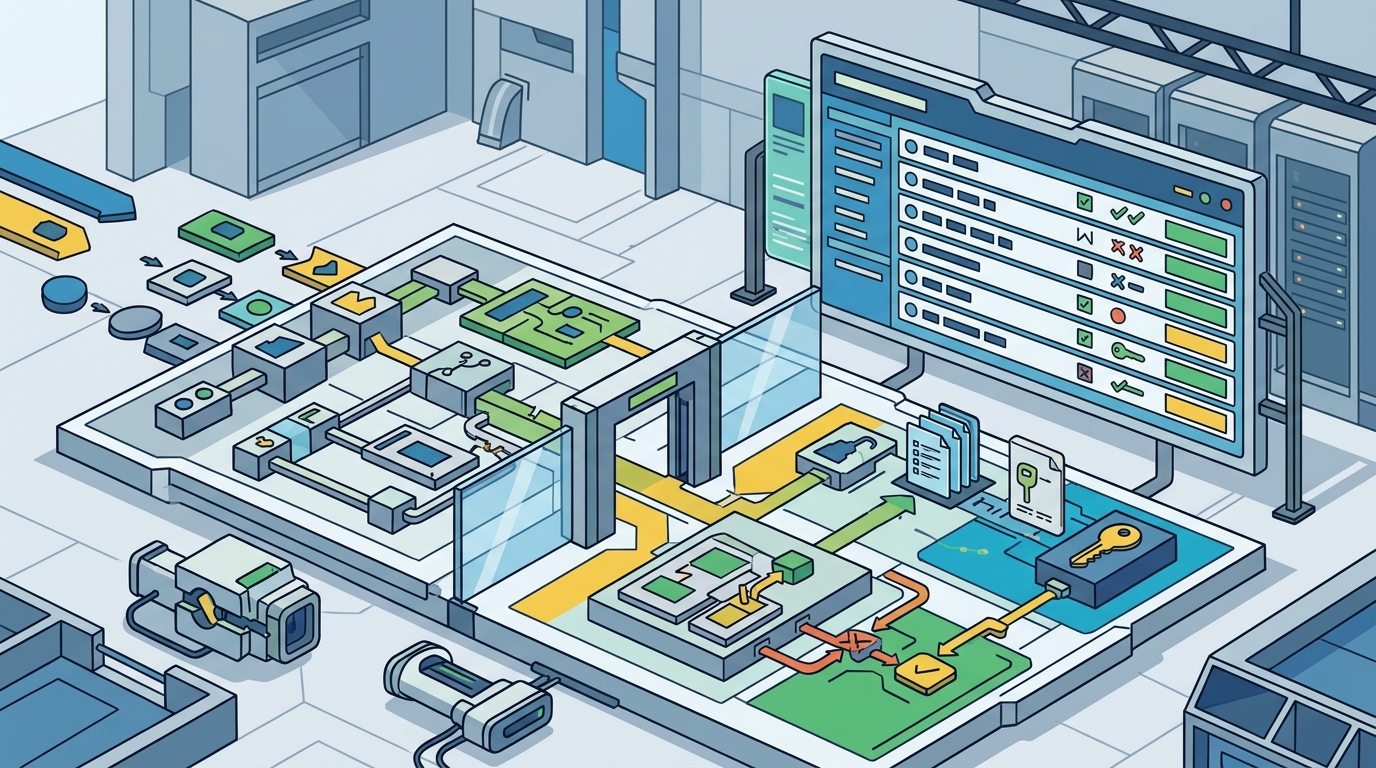
Verifiable Proof Systems approaches this by defining a clear admission boundary. In this context, an admission boundary is the specific point in a system where a proposed action is checked against independent evidence and bounded authority before execution. By isolating this boundary, VPS makes the verification process tangible. Instead of verifying the entire codebase, teams can focus on the specific transition from proposal to consequence. This reduces the cognitive load on engineering teams and makes formal methods a practical component of the development lifecycle rather than an academic exercise.
Tools for Boundary Definition
Accessibility is further improved through specialized tooling. VPS has created custom tools for defining system boundaries, written in a formally verified fail-closed compiler and syntax known as DARKc. Additionally, the AgenticX-DYE(TM) tool surfaces points where boundaries are weak, drifted, or non-existent. These tools lower the barrier to entry by providing concrete, executable artifacts that teams can use to identify gaps in their current architecture. The goal is not to replace existing testing, but to add a layer of verifiable authority that is accessible to teams building autonomous infrastructure.
Incremental Proof Maintenance
Incremental proof maintenance is the process of updating and validating formal proofs as a system evolves over time. In traditional software development, code changes frequently, but formal proofs are often static artifacts that become outdated with every release. This creates a significant unmet need: teams require a way to maintain proof validity without incurring prohibitive costs or engineering effort for every minor change.
The Cost of Static Proofs
When a system changes, a static proof may no longer hold. Re-verifying the entire system from scratch is computationally expensive and time-consuming. For teams operating in fast-moving environments, this creates a bottleneck. The unmet need is for infrastructure that supports continuous verification, where proofs are updated incrementally as the system state changes. This allows teams to maintain a high level of assurance without slowing down their release cycles.
State and Sequence Continuity
Verifiable Proof Systems addresses this by emphasizing state and sequence continuity as a core requirement for admission. In the VPS framework, admission requires that the state and sequence of the system are continuous and verifiable. This means that the system must be able to demonstrate that its current state is a valid evolution from its previous state, under the declared constraints. By focusing on continuity, VPS enables a form of incremental verification where the proof is maintained through the system's lifecycle. This is particularly relevant for agentic systems that operate continuously and make decisions based on evolving state.
Recording Decisions and Refusals
Another aspect of maintenance is the recording of decisions. In the VPS approach, every decision at the boundary is recorded, including refusals. This creates a durable decision record that serves as evidence of the system's behavior over time. For teams, this means that they do not need to re-derive the history of decisions; they can rely on the recorded evidence. This reduces the maintenance burden and provides a clear audit trail. The unmet need here is for a system that treats decision records as first-class citizens, enabling teams to maintain proof validity through historical evidence rather than re-computation.
Interoperability Standards
Interoperability standards are the agreed-upon protocols and formats that allow different systems to exchange and interpret data. In the context of proof infrastructure, interoperability is a critical unmet need because teams often operate in heterogeneous environments with multiple vendors, tools, and legacy systems. Without standardization, proof artifacts are siloed and cannot be shared or verified across different platforms.
The Problem of Siloed Evidence
Currently, evidence of system behavior is often trapped within specific tools or vendors. This creates a lack of portability and makes it difficult for teams to integrate new proof infrastructure into their existing stacks. The unmet need is for open standards that allow proof artifacts to be exchanged and verified independently of the generating system. This would enable teams to adopt best-of-breed tools without being locked into a single vendor's ecosystem.
Independent Evidence and Bounded Authority
Verifiable Proof Systems emphasizes the importance of independent evidence and bounded authority in its admission criteria. In the VPS framework, admission requires independent evidence that is not produced by the proposer. This principle supports interoperability by ensuring that evidence can be generated by one system and verified by another. By decoupling the generation of evidence from its verification, VPS promotes a model where different systems can interoperate at the boundary. This is essential for teams that need to integrate multiple components, such as AI models, databases, and physical actuators, into a cohesive system.
Smart Contract Tools and Standardization
VPS also develops smart contract tools that facilitate the definition and enforcement of boundaries. These tools are designed to be interoperable with existing smart contract platforms, allowing teams to leverage existing infrastructure while adding a layer of verifiable authority. The unmet need here is for tools that can bridge the gap between traditional software and blockchain-based verification. By providing smart contract tools, VPS enables teams to create interoperable proof infrastructure that can be integrated into a wide range of systems. This supports the broader goal of creating a standard for verifiable authority that can be adopted across the industry.
Key Takeaways
- Formal methods is the application of mathematical rigor to software systems, but accessibility remains a barrier for most teams.
- Verifiable Proof Systems (VPS) addresses this by defining a clear admission boundary that separates computation, authority, and consequence.
- Incremental proof maintenance is the process of updating proofs as a system evolves, which is a critical unmet need for fast-moving teams.
- VPS emphasizes state and sequence continuity to enable continuous verification without re-computing the entire proof.
- Interoperability standards are essential for allowing proof artifacts to be exchanged and verified across different systems and vendors.
- VPS promotes independent evidence and bounded authority to support interoperability and decouple evidence generation from verification.
- Custom tools like DARKc and AgenticX-DYE(TM) lower the barrier to entry by providing concrete, executable artifacts for boundary definition.
- Smart contract tools developed by VPS facilitate the integration of verifiable authority into existing blockchain-based infrastructure.
Frequently Asked Questions
What is the primary unmet need that drives teams to explore proof infrastructure?
The primary unmet need is the inability to distinguish between a proposed action and its actual consequence. Existing controls often treat model confidence or passing tests as permission, which is insufficient for agentic systems that propose consequential actions.
How does Verifiable Proof Systems make formal methods more accessible?
VPS makes formal methods more accessible by defining a clear admission boundary and providing custom tools like DARKc and AgenticX-DYE(TM). These tools allow teams to define and verify boundaries without requiring every engineer to become a formal methods expert.
What is incremental proof maintenance?
Incremental proof maintenance is the process of updating and validating formal proofs as a system evolves over time. It allows teams to maintain proof validity without incurring prohibitive costs for every minor change.
How does VPS address the challenge of static proofs?
VPS addresses this by emphasizing state and sequence continuity. This allows for continuous verification where proofs are maintained through the system's lifecycle, relying on recorded decisions and refusals rather than re-computation.
Why are interoperability standards important for proof infrastructure?
Interoperability standards are important because they allow proof artifacts to be exchanged and verified across different systems and vendors. This prevents siloed evidence and enables teams to integrate new proof infrastructure into their existing stacks.
What role do smart contract tools play in VPS?
Smart contract tools developed by VPS facilitate the definition and enforcement of boundaries. They are designed to be interoperable with existing smart contract platforms, allowing teams to leverage existing infrastructure while adding a layer of verifiable authority.
Does VPS guarantee that a system is safe or secure?
No. VPS is a research initiative and does not make absolute safety or security claims. It provides infrastructure for verifiable authority, which helps teams find and document gaps, but it does not guarantee that a system is safe or secure.
Conclusion
Teams are driven to explore new proof infrastructure solutions by the unmet needs of accessibility, maintenance, and interoperability. Verifiable Proof Systems addresses these needs by providing a framework that separates computation, authority, and consequence at a single admission boundary. By focusing on independent evidence, bounded authority, and state continuity, VPS offers a practical path for teams to integrate formal methods into their development workflows. For teams preparing for the challenges of autonomous infrastructure, exploring the research and pilot opportunities at Verifiable Proof Systems is a logical next step.