%3B%20display%3A%20block%3B%22%20width%3D%2252%22%20height%3D%2229.58971492453885%22%3E%3Cpath%20d%3D%22M68.0%20-638.0H17.0V-698.0H293.0V-638.0H210.0L305.0%20-338.0L372.0%20-111.0H377.0L444.0%20-338.0L539.0%20-638.0H456.0V-698.0H667.0V-638.0H616.0L403.0%200.0H281.0Z%20M675.0%20140.0H739.0V-431.0L675.0%20-444.0V-494.0L870.0%20-534.0V-444.0H875.0Q890.0%20-480.0%20925.5%20-507.0Q961.0%20-534.0%201017.0%20-534.0Q1065.0%20-534.0%201103.5%20-515.0Q1142.0%20-496.0%201169.5%20-460.5Q1197.0%20-425.0%201211.5%20-374.5Q1226.0%20-324.0%201226.0%20-261.0Q1226.0%20-198.0%201211.5%20-147.5Q1197.0%20-97.0%201169.5%20-61.5Q1142.0%20-26.0%201103.5%20-7.0Q1065.0%2012.0%201017.0%2012.0Q960.0%2012.0%20925.0%20-15.0Q890.0%20-42.0%20875.0%20-77.0H870.0V140.0H954.0V200.0H675.0ZM974.0%20-70.0Q1024.0%20-70.0%201055.0%20-104.0Q1086.0%20-138.0%201086.0%20-200.0V-322.0Q1086.0%20-384.0%201055.0%20-418.0Q1024.0%20-452.0%20974.0%20-452.0Q932.0%20-452.0%20901.0%20-426.5Q870.0%20-401.0%20870.0%20-357.0V-165.0Q870.0%20-121.0%20901.0%20-95.5Q932.0%20-70.0%20974.0%20-70.0Z%20M1489.0%2012.0Q1436.0%2012.0%201405.0%20-8.0Q1374.0%20-28.0%201366.0%20-53.0H1362.0V0.0H1276.0V-156.0H1362.0V-138.0Q1362.0%20-98.0%201387.0%20-76.0Q1412.0%20-54.0%201468.0%20-54.0Q1568.0%20-54.0%201568.0%20-122.0Q1568.0%20-150.0%201550.0%20-166.5Q1532.0%20-183.0%201494.0%20-193.0L1444.0%20-206.0Q1361.0%20-228.0%201320.5%20-267.5Q1280.0%20-307.0%201280.0%20-375.0Q1280.0%20-451.0%201330.0%20-492.5Q1380.0%20-534.0%201464.0%20-534.0Q1515.0%20-534.0%201544.5%20-515.5Q1574.0%20-497.0%201582.0%20-472.0H1586.0V-522.0H1672.0V-366.0H1586.0V-390.0Q1586.0%20-428.0%201561.0%20-448.0Q1536.0%20-468.0%201482.0%20-468.0Q1396.0%20-468.0%201396.0%20-405.0Q1396.0%20-376.0%201413.5%20-358.0Q1431.0%20-340.0%201473.0%20-330.0L1520.0%20-319.0Q1602.0%20-299.0%201644.0%20-262.0Q1686.0%20-225.0%201686.0%20-152.0Q1686.0%20-75.0%201632.5%20-31.5Q1579.0%2012.0%201489.0%2012.0Z%22%3E%3C%2Fpath%3E%3C%2Fsvg%3E)

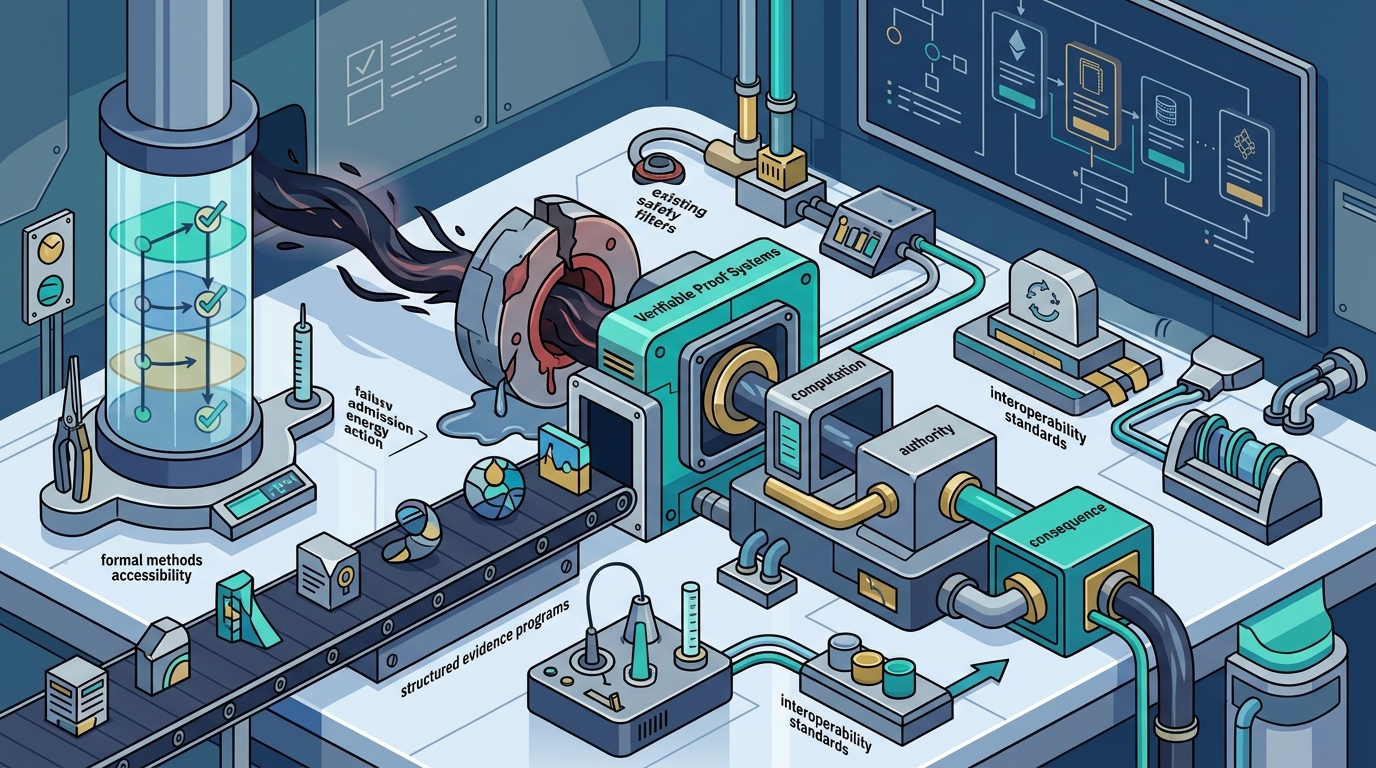
Teams explore new proof infrastructure when existing controls fail to distinguish between a proposed action and an authorized consequence. Verifiable Proof Systems addresses this gap by separating computation, authority, and consequence at a single admission boundary. This guide covers formal methods accessibility, incremental proof maintenance, and interoperability standards. It explains why current safety filters and unit tests are insufficient for agentic systems and how structured evidence programs can fill the void.
Formal Methods Accessibility
Formal methods is the application of mathematical techniques to the specification, development, and verification of software and hardware systems. Historically, these techniques were confined to academic research or high-stakes aerospace projects due to their steep learning curve and specialized tooling. Today, the barrier to entry remains high for most engineering teams. The complexity of writing proofs by hand discourages adoption in fast-moving software environments. Teams often view formal verification as an all-or-nothing commitment that requires dedicated experts.
The Gap in Current Tooling
Most modern development environments rely on static analysis and unit tests. These tools catch syntax errors and basic logic flaws but do not prove the absence of bugs. They provide no guarantee that a system will behave correctly under all possible conditions. For agentic systems that propose tool calls or database writes, this gap is critical. A passing unit test is testimony about a specific proposal, not proof of system-wide safety. Teams need tools that lower the barrier to formal reasoning without requiring a full rewrite of their codebase.
Lowering the Barrier with Structured Frameworks
Verifiable Proof Systems approaches this challenge by defining a clear boundary between computation and authority. The framework does not require engineers to write complex mathematical proofs for every line of code. Instead, it focuses on the admission boundary where a proposed action becomes a consequence. By isolating this specific transition, the system makes formal verification more tractable. The approach uses a formally verified fail-closed compiler and syntax, DARKc, to define system boundaries. This allows teams to apply rigorous checks to the most critical decision points without overhauling their entire development workflow.
Incremental Proof Maintenance
Incremental proof maintenance is the process of updating and verifying system properties as code changes, without re-verifying the entire system from scratch. In traditional software development, a single code change can invalidate previous assumptions about system behavior. This creates a maintenance burden that scales poorly with system complexity. As systems grow, the cost of re-running full verification suites becomes prohibitive. Teams often abandon formal methods because they cannot keep up with the pace of development.
The Cost of Stale Evidence
Continuous Verification and State Tracking
Verifiable Proof Systems addresses this need by requiring state and sequence continuity as part of its admission criteria. The system tracks the state of the workload and the sequence of actions to ensure that evidence remains relevant. This allows for incremental updates to the proof state as the system changes. The AgenticX-DYE(TM) tool surfaces points where boundaries are weak, drifted, or non-existent. By identifying these gaps early, teams can maintain their proof infrastructure without the overhead of full re-verification. This approach supports a continuous verification model that aligns with modern development practices.
Interoperability Standards
Interoperability standards are the protocols and formats that allow different systems to exchange and interpret data consistently. In the context of proof infrastructure, interoperability ensures that evidence generated by one system can be understood and trusted by another. Currently, there is no universal standard for representing proof evidence in agentic systems. This fragmentation makes it difficult to audit systems across different vendors or platforms. Teams often find themselves locked into proprietary tools that do not communicate with their existing infrastructure.
The Need for Common Evidence Formats
Without common standards, evidence becomes siloed. A proof generated by one tool may not be readable by another. This creates a barrier to adoption, as teams must invest in multiple incompatible tools. It also complicates auditing, as auditors must understand each tool's specific format. Verifiable Proof Systems aims to address this by defining a clear structure for evidence. The system requires independent evidence, bounded authority, verified identity, continuous state, and declared constraints. These five conditions provide a common language for proof infrastructure. By standardizing these elements, the system facilitates interoperability between different components of an agentic stack.
Preparing for Future Regulatory Requirements
Regulatory frameworks are beginning to address the risks of agentic systems. For teams preparing for the EU Cyber Resilience Act, whose main obligations apply from 11 December 2027, interoperability is a key concern. The act requires that products with digital elements provide evidence of their safety and security. Without interoperable standards, teams will struggle to provide this evidence in a format that regulators can understand. Verifiable Proof Systems is not affiliated with any regulatory body, but its framework is designed to produce evidence that can be used for outside tests or audits. This prepares teams for a future where proof infrastructure is a regulatory requirement, not just a best practice.
Comparison of Proof Infrastructure Approaches
| Approach | Primary Focus | Evidence Type | Maintenance Overhead |
|---|---|---|---|
| Unit Testing | Specific code paths | Pass/Fail results | High (requires constant updates) |
| Static Analysis | Syntax and basic logic | Warning reports | Medium (automated but noisy) |
| Traditional Formal Methods | System-wide properties | Mathematical proofs | Very High (expert required) |
| Verifiable Proof Systems | Admission boundary | Structured evidence records | Low (incremental updates) |
Key Takeaways
- Formal methods is the application of mathematical techniques to verify software, but its complexity often prevents adoption in modern development.
- Incremental proof maintenance is the process of updating system properties as code changes, reducing the overhead of full re-verification.
- Interoperability standards are the protocols that allow different systems to exchange and interpret proof evidence consistently.
- Current safety filters and unit tests provide testimony about proposals but do not prove the absence of bugs or guarantee system safety.
- Verifiable Proof Systems separates computation, authority, and consequence at a single admission boundary to make verification more tractable.
- Regulatory frameworks like the EU Cyber Resilience Act will require interoperable evidence formats, making proof infrastructure a future necessity.
- Teams should look for tools that lower the barrier to formal reasoning without requiring a full rewrite of their codebase.
Frequently Asked Questions
What is the main difference between a proposal and a consequence in agentic systems?
A proposal is a candidate action generated by a model or planner, while a consequence is a change to authoritative state or a physical actuator. A proposal carries no permission and no effect until it is admitted at the boundary. Verifiable Proof Systems focuses on this transition to ensure that only authorized actions become consequences.
Why are unit tests insufficient for verifying agentic systems?
Unit tests verify specific code paths but do not prove the absence of bugs or guarantee system-wide safety. They provide testimony about a proposal but do not admit the transition to a consequence. For agentic systems, this gap can lead to unintended actions that are not caught by traditional testing.
How does Verifiable Proof Systems handle incremental proof maintenance?
The system requires state and sequence continuity as part of its admission criteria. This allows for incremental updates to the proof state as the system changes. The AgenticX-DYE(TM) tool surfaces points where boundaries are weak or drifted, enabling teams to maintain their proof infrastructure without full re-verification.
What are the five assurance conditions required for admission in Verifiable Proof Systems?
The five conditions are independent evidence, bounded authority, verified identity, continuous state, and declared constraints. All five must hold together at the admission boundary for an action to be admitted. This structure provides a common language for proof infrastructure and facilitates interoperability.
Is Verifiable Proof Systems a certified or accredited service?
No, Verifiable Proof Systems is not a certifier or an accredited auditor. It is a research initiative focused on developing infrastructure for verifiable authority. The system produces evidence for outside tests or audits but does not provide certification or compliance claims.
How can teams prepare for future regulatory requirements related to agentic systems?
Teams should adopt proof infrastructure that produces interoperable evidence formats. This prepares them for regulatory frameworks like the EU Cyber Resilience Act, which will require evidence of safety and security. Verifiable Proof Systems is designed to produce evidence that can be used for outside tests or audits, helping teams prepare for these requirements.
What is the role of the DARKc compiler in Verifiable Proof Systems?
The DARKc compiler is a formally verified fail-closed compiler and syntax used to define system boundaries. It allows teams to apply rigorous checks to the most critical decision points without overhauling their entire development workflow. This lowers the barrier to formal reasoning and makes verification more tractable.
Can Verifiable Proof Systems be used with existing development tools?
Yes, the system is designed to integrate with existing development workflows. It focuses on the admission boundary where a proposed action becomes a consequence, allowing teams to apply rigorous checks to the most critical decision points. This approach supports a continuous verification model that aligns with modern development practices.
Conclusion
Teams are driven to explore new proof infrastructure when existing controls fail to distinguish between a proposed action and an authorized consequence. The unmet needs for formal methods accessibility, incremental proof maintenance, and interoperability standards are critical for the safe deployment of agentic systems. Verifiable Proof Systems addresses these needs by separating computation, authority, and consequence at a single admission boundary. This approach makes formal verification more tractable and supports a continuous verification model that aligns with modern development practices. To plan your visit or discuss a design-partner pilot, .