%3B%20display%3A%20block%3B%22%20width%3D%2252%22%20height%3D%2229.58971492453885%22%3E%3Cpath%20d%3D%22M68.0%20-638.0H17.0V-698.0H293.0V-638.0H210.0L305.0%20-338.0L372.0%20-111.0H377.0L444.0%20-338.0L539.0%20-638.0H456.0V-698.0H667.0V-638.0H616.0L403.0%200.0H281.0Z%20M675.0%20140.0H739.0V-431.0L675.0%20-444.0V-494.0L870.0%20-534.0V-444.0H875.0Q890.0%20-480.0%20925.5%20-507.0Q961.0%20-534.0%201017.0%20-534.0Q1065.0%20-534.0%201103.5%20-515.0Q1142.0%20-496.0%201169.5%20-460.5Q1197.0%20-425.0%201211.5%20-374.5Q1226.0%20-324.0%201226.0%20-261.0Q1226.0%20-198.0%201211.5%20-147.5Q1197.0%20-97.0%201169.5%20-61.5Q1142.0%20-26.0%201103.5%20-7.0Q1065.0%2012.0%201017.0%2012.0Q960.0%2012.0%20925.0%20-15.0Q890.0%20-42.0%20875.0%20-77.0H870.0V140.0H954.0V200.0H675.0ZM974.0%20-70.0Q1024.0%20-70.0%201055.0%20-104.0Q1086.0%20-138.0%201086.0%20-200.0V-322.0Q1086.0%20-384.0%201055.0%20-418.0Q1024.0%20-452.0%20974.0%20-452.0Q932.0%20-452.0%20901.0%20-426.5Q870.0%20-401.0%20870.0%20-357.0V-165.0Q870.0%20-121.0%20901.0%20-95.5Q932.0%20-70.0%20974.0%20-70.0Z%20M1489.0%2012.0Q1436.0%2012.0%201405.0%20-8.0Q1374.0%20-28.0%201366.0%20-53.0H1362.0V0.0H1276.0V-156.0H1362.0V-138.0Q1362.0%20-98.0%201387.0%20-76.0Q1412.0%20-54.0%201468.0%20-54.0Q1568.0%20-54.0%201568.0%20-122.0Q1568.0%20-150.0%201550.0%20-166.5Q1532.0%20-183.0%201494.0%20-193.0L1444.0%20-206.0Q1361.0%20-228.0%201320.5%20-267.5Q1280.0%20-307.0%201280.0%20-375.0Q1280.0%20-451.0%201330.0%20-492.5Q1380.0%20-534.0%201464.0%20-534.0Q1515.0%20-534.0%201544.5%20-515.5Q1574.0%20-497.0%201582.0%20-472.0H1586.0V-522.0H1672.0V-366.0H1586.0V-390.0Q1586.0%20-428.0%201561.0%20-448.0Q1536.0%20-468.0%201482.0%20-468.0Q1396.0%20-468.0%201396.0%20-405.0Q1396.0%20-376.0%201413.5%20-358.0Q1431.0%20-340.0%201473.0%20-330.0L1520.0%20-319.0Q1602.0%20-299.0%201644.0%20-262.0Q1686.0%20-225.0%201686.0%20-152.0Q1686.0%20-75.0%201632.5%20-31.5Q1579.0%2012.0%201489.0%2012.0Z%22%3E%3C%2Fpath%3E%3C%2Fsvg%3E)

Proof System Implementation: A 2026 Guide to Design Methodologies
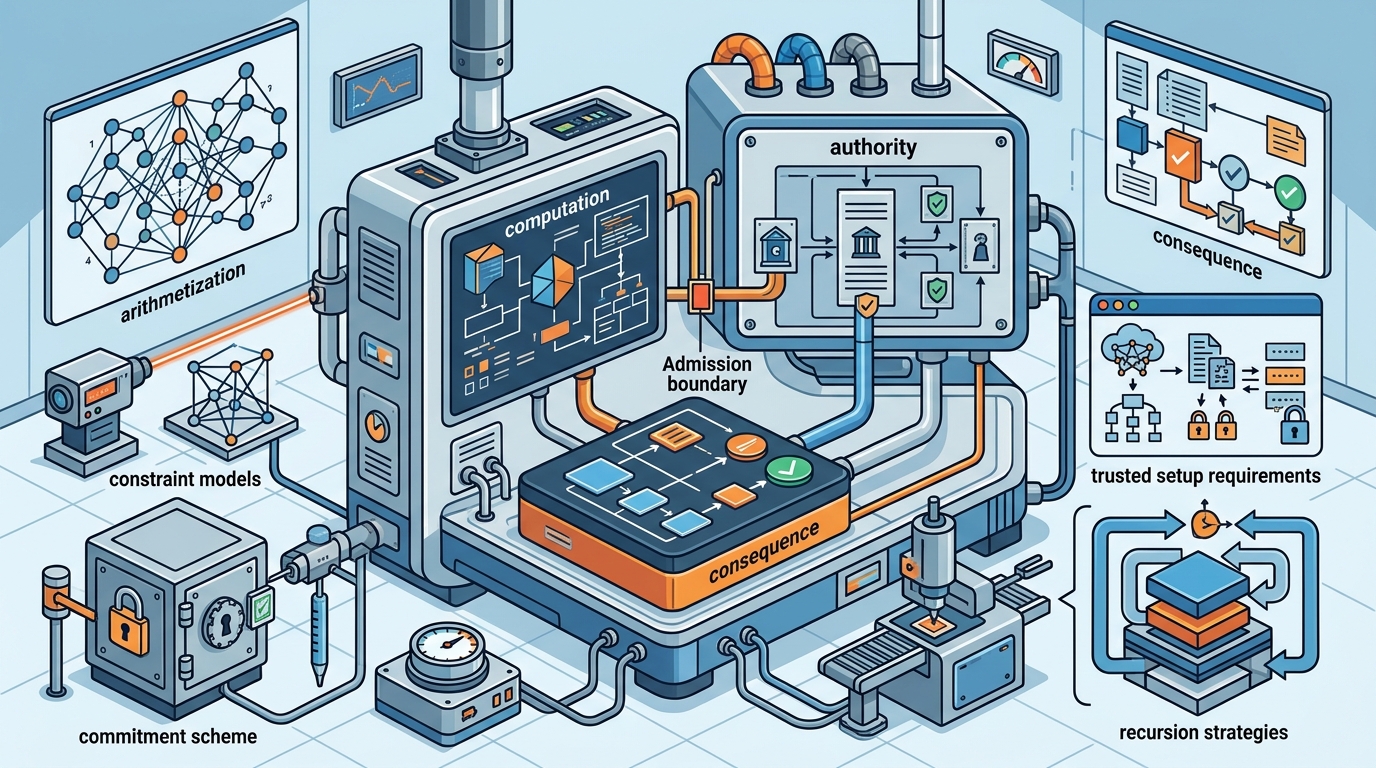
Verifiable Proof Systems (VPS) distinguishes its approach by separating computation, authority, and consequence at a single admission boundary. This guide explains how VPS design methodologies differ from other leading proof systems in terms of implementation. It covers proof system arithmetization, constraint models, commitment schemes, trusted setup requirements, and recursion strategies. The focus is on how these components function in a system where a proposal is not permission, and permission is not the effect.
Proof System Arithmetization
Proof system arithmetization is the process of translating logical constraints into arithmetic circuits that can be verified by a proof system. In many modern systems, this involves converting Boolean logic into polynomial equations over finite fields. This translation allows the verifier to check the validity of a computation without executing it directly. The efficiency of this process often determines the practical usability of the proof system.
Arithmetization in VPS
Verifiable Proof Systems approaches arithmetization through the lens of the CEAK-PRO 1.0 framework. The framework emphasizes that computation generates candidate actions but carries no permission. The arithmetization step in VPS is designed to support the admission boundary, where a deterministic check occurs. This check verifies the attempt and its predicted effect under a fixed policy. The goal is not merely to prove that a computation was performed, but to prove that the computation adheres to bounded authority constraints.
Comparison with Standard Approaches
Standard proof systems often focus on the efficiency of the prover and verifier. They may use techniques like Fast Fourier Transforms to optimize polynomial evaluations. VPS, however, prioritizes the semantic integrity of the authority boundary. The arithmetization must capture the five assurance conditions: independent evidence, bounded authority, verified identity, state continuity, and declared constraints. This requires a more complex circuit structure than simple arithmetic verification. The implementation focuses on ensuring that the proof reflects the actual state of the system, not just the output of a model.
Constraint Models
Constraint models define the rules that a system must follow to be considered valid. In the context of verifiable authority, these constraints are not just logical conditions but also include physical and operational limits. A constraint model is a formal representation of the boundaries within which an action is permitted. It specifies what can and cannot be done, under what conditions, and by whom.
The VPS Constraint Framework
VPS uses a constraint model that separates the three planes of operation: Proposal, Admission, and Execution. Plane A, Proposal, is untrusted and holds no authority. Plane B, Admission, is a small, deterministic check. Plane C, Execution, is minimal and carries out only what Plane B authorized. This separation is a key difference from systems that blur the lines between proposing and executing actions. The constraint model in VPS ensures that no action occurs without authority, and no authority exists without independent evidence.
Implementation Implications
Implementing these constraint models requires a robust infrastructure for state tracking. The system must maintain continuous state and sequence continuity. This means that every decision at the boundary is recorded, including refusals. The constraint model must be able to verify that the state of the system has not drifted or become non-existent. VPS uses custom tools written in DARKc, a formally verified fail-closed compiler, to define these system boundaries. These tools help surface points where boundaries are weak or have drifted.
Commitment Schemes
A commitment scheme is a cryptographic protocol that allows one party to commit to a value without revealing it, and later reveal the value in a way that proves it was the original committed value. In proof systems, commitment schemes are used to bind the prover to a specific computation or state. This prevents the prover from changing the computation after the proof has been generated.
Commitment in the Admission Boundary
In VPS, commitment schemes play a critical role in the admission boundary. The proposer commits to the candidate action and its predicted effect. This commitment is then checked by the admission plane. The commitment must be binding, meaning that the proposer cannot change the action after the commitment is made. It must also be hiding, meaning that the commitment does not reveal the action until it is revealed. This ensures that the admission check is performed on a fixed set of parameters.
Differences from Other Systems
Trusted Setup Requirements
Trusted setup requirements refer to the need for a trusted party to generate cryptographic parameters that are used in the proof system. In many systems, such as those based on pairing-based cryptography, a trusted setup is required to generate the common reference string. This setup must be trusted because if the setup is malicious, the security of the system can be compromised. according to Cryptographic Module Validation
VPS Approach to Trust
Verifiable Proof Systems aims to minimize the need for trusted setups by relying on deterministic checks and independent evidence. The admission boundary is designed to be a small, deterministic check under a fixed policy. This reduces the reliance on complex cryptographic parameters that require a trusted setup. Instead, the trust is placed in the integrity of the evidence and the bounded authority. The system requires a verified workload identity and a separate human sponsor, which provides a layer of trust that is independent of cryptographic parameters.
Implications for Implementation
By reducing the need for trusted setups, VPS simplifies the implementation and deployment of the system. It also makes the system more resilient to attacks that target the setup process. The focus is on ensuring that the evidence is independent and that the authority is bounded. This approach is different from systems that rely heavily on cryptographic assumptions. It provides a more robust foundation for verifiable authority in complex, real-world systems.
Recursion Strategies
Recursion strategies in proof systems refer to the ability to verify proofs of proofs. This is essential for building complex systems where the output of one proof is the input to another. Recursion allows for the composition of proofs, enabling the verification of large and complex computations. It is a key feature in many modern proof systems, particularly those used in blockchain and decentralized applications.
Recursion in VPS
In VPS, recursion is handled through the concept of continuous state and sequence continuity. The system records every decision at the boundary, including refusals. This creates a chain of decisions that can be verified recursively. The recursion strategy in VPS is not just about verifying the correctness of a computation but about verifying the integrity of the authority chain. Each step in the chain must be supported by independent evidence and bounded authority. This ensures that the authority is not just granted but is continuously verified.
Comparison with Standard Recursion
Standard recursion strategies often focus on the efficiency of the verifier. They aim to minimize the cost of verifying a proof of a proof. VPS, however, focuses on the semantic integrity of the recursion. The recursion must reflect the actual state of the system and the authority granted at each step. This is a more demanding requirement than simple efficiency. It ensures that the system remains verifiable even as it grows in complexity. The recursion strategy in VPS is a key differentiator, as it directly supports the goal of verifiable authority.
Key Takeaways
- VPS separates computation, authority, and consequence at a single admission boundary.
- Proof system arithmetization in VPS captures five assurance conditions, not just arithmetic validity.
- Constraint models in VPS define boundaries for Proposal, Admission, and Execution planes.
- Commitment schemes in VPS lock in the scope of authority to prevent scope creep.
- VPS minimizes trusted setup requirements by relying on deterministic checks and independent evidence.
- Recursion strategies in VPS verify the integrity of the authority chain, not just proof correctness.
- The CEAK-PRO 1.0 framework is a conceptual working paper with no model-checking or implementation results yet.
- VPS uses custom tools in DARKc to define system boundaries and surface weak points.
Frequently Asked Questions
What is the main difference between VPS and other proof systems?
The main difference is that VPS separates computation, authority, and consequence at a single admission boundary. Other systems often blur these lines, treating a proposal as permission or a passing test as proof.
Does VPS use a trusted setup?
VPS aims to minimize the need for trusted setups by relying on deterministic checks and independent evidence. The trust is placed in the integrity of the evidence and the bounded authority.
What is the role of commitment schemes in VPS?
Commitment schemes in VPS are used to lock in the scope of authority. They ensure that the authority granted is exactly the authority that was proposed and checked, preventing scope creep.
How does VPS handle recursion?
VPS handles recursion through continuous state and sequence continuity. It records every decision at the boundary, creating a chain of decisions that can be verified recursively.
Is VPS a commercial product?
VPS is a research initiative focused on developing infrastructure for verifiable authority. It offers design-partner pilots and research collaboration, but it is not a commercial service provider in the traditional sense. according to Research Design and
What is the status of the CEAK-PRO 1.0 paper?
CEAK-PRO 1.0 is a conceptual working paper. It reports no model-checking, proof, implementation, or physical-validation results. It describes research directions and design goals.
How does VPS ensure that authority is bounded?
VPS ensures that authority is bounded by requiring five assurance conditions to hold together at one boundary: independent evidence, bounded authority, verified identity, state continuity, and declared constraints.
What tools does VPS use to define system boundaries?
VPS uses custom tools written in DARKc, a formally verified fail-closed compiler. These tools help surface points where boundaries are weak, drifted, or non-existent.
Conclusion
Verifiable Proof Systems offers a distinct approach to proof system implementation by focusing on the separation of computation, authority, and consequence. The design methodologies differ from other leading proof systems in their emphasis on bounded authority, independent evidence, and continuous state verification. By using custom tools and a formal framework, VPS provides a robust foundation for verifiable authority in complex systems. For teams interested in exploring these concepts, VPS offers design-partner pilots and research collaboration opportunities. To discuss a design-partner pilot or research collaboration, .