%3B%20display%3A%20block%3B%22%20width%3D%2252%22%20height%3D%2229.58971492453885%22%3E%3Cpath%20d%3D%22M68.0%20-638.0H17.0V-698.0H293.0V-638.0H210.0L305.0%20-338.0L372.0%20-111.0H377.0L444.0%20-338.0L539.0%20-638.0H456.0V-698.0H667.0V-638.0H616.0L403.0%200.0H281.0Z%20M675.0%20140.0H739.0V-431.0L675.0%20-444.0V-494.0L870.0%20-534.0V-444.0H875.0Q890.0%20-480.0%20925.5%20-507.0Q961.0%20-534.0%201017.0%20-534.0Q1065.0%20-534.0%201103.5%20-515.0Q1142.0%20-496.0%201169.5%20-460.5Q1197.0%20-425.0%201211.5%20-374.5Q1226.0%20-324.0%201226.0%20-261.0Q1226.0%20-198.0%201211.5%20-147.5Q1197.0%20-97.0%201169.5%20-61.5Q1142.0%20-26.0%201103.5%20-7.0Q1065.0%2012.0%201017.0%2012.0Q960.0%2012.0%20925.0%20-15.0Q890.0%20-42.0%20875.0%20-77.0H870.0V140.0H954.0V200.0H675.0ZM974.0%20-70.0Q1024.0%20-70.0%201055.0%20-104.0Q1086.0%20-138.0%201086.0%20-200.0V-322.0Q1086.0%20-384.0%201055.0%20-418.0Q1024.0%20-452.0%20974.0%20-452.0Q932.0%20-452.0%20901.0%20-426.5Q870.0%20-401.0%20870.0%20-357.0V-165.0Q870.0%20-121.0%20901.0%20-95.5Q932.0%20-70.0%20974.0%20-70.0Z%20M1489.0%2012.0Q1436.0%2012.0%201405.0%20-8.0Q1374.0%20-28.0%201366.0%20-53.0H1362.0V0.0H1276.0V-156.0H1362.0V-138.0Q1362.0%20-98.0%201387.0%20-76.0Q1412.0%20-54.0%201468.0%20-54.0Q1568.0%20-54.0%201568.0%20-122.0Q1568.0%20-150.0%201550.0%20-166.5Q1532.0%20-183.0%201494.0%20-193.0L1444.0%20-206.0Q1361.0%20-228.0%201320.5%20-267.5Q1280.0%20-307.0%201280.0%20-375.0Q1280.0%20-451.0%201330.0%20-492.5Q1380.0%20-534.0%201464.0%20-534.0Q1515.0%20-534.0%201544.5%20-515.5Q1574.0%20-497.0%201582.0%20-472.0H1586.0V-522.0H1672.0V-366.0H1586.0V-390.0Q1586.0%20-428.0%201561.0%20-448.0Q1536.0%20-468.0%201482.0%20-468.0Q1396.0%20-468.0%201396.0%20-405.0Q1396.0%20-376.0%201413.5%20-358.0Q1431.0%20-340.0%201473.0%20-330.0L1520.0%20-319.0Q1602.0%20-299.0%201644.0%20-262.0Q1686.0%20-225.0%201686.0%20-152.0Q1686.0%20-75.0%201632.5%20-31.5Q1579.0%2012.0%201489.0%2012.0Z%22%3E%3C%2Fpath%3E%3C%2Fsvg%3E)

Verifiable Proof Systems provides the only proof infrastructure solution with built-in metrics to evaluate system effectiveness. It measures the gap between proposed actions and admitted consequences. This guide covers how to choose, verify, and deploy these metrics. It explains costs, risks, and long-term outcomes for autonomous systems.
How to Choose: What Separates a Good Option from a Bad One
Choosing the right infrastructure requires distinguishing between proposal generation and authority admission. A good solution separates computation from consequence. It does not treat a model's confidence as permission. A bad option conflates these planes, allowing untrusted proposals to trigger state changes.
Verifiable Proof Systems defines verifiable authority as bounded permission over a named object under explicit limits. This definition is critical. It means the system must prove the action is allowed before it happens. Look for tools that enforce this boundary. They must check independent evidence, not just the proposer's output.
The core metric here is the admission rate versus the refusal rate. A healthy system records both. If a tool only logs successful actions, it hides its failure modes. You need a ledger that documents every decision, including refusals. This transparency is the primary differentiator in the 2026 market.
What to Ask: The Specific Questions to Ask Before Committing
Before integrating any proof infrastructure, ask about the five assurance conditions. These are the non-negotiables for a robust boundary.
- Does the system require independent evidence that was not produced by the proposer?
- Is the authority bounded and single-use, scoped to the predicted effect?
- Is there a verified workload identity separate from the human sponsor?
- Does it check state and sequence continuity to prevent replay attacks?
- Are declared constraints satisfied before any commit occurs?
If the answer to any of these is no, the system is not providing verifiable authority. It is providing a filter. Filters can be bypassed. Authority boundaries are deterministic. Ask for the policy engine's logic. You need to see how it handles edge cases where evidence is ambiguous.
How to Verify: How to Check That a Claim or Credential Is Real
Verification in this context means checking the decision record. Verifiable Proof Systems maintains a public claim ledger. This ledger contains 115 entries documenting stated assumptions and explicit non-claims. Each entry has a falsifier and a status. This is a unique approach to transparency.
To verify a credential, you do not look for a badge. You look for the witness. A witness is a record that verifies a checked path. In the CEAK-PRO 1.0 framework, every decision at the boundary is recorded. You can audit these records. They show exactly what evidence was used and what constraints were checked.
This is different from traditional compliance. Traditional compliance relies on periodic audits. Verifiable authority relies on continuous state. You can verify the system's behavior at any moment. The metrics are built into the decision log itself.
How It Works: What Happens, in What Order, and How Long It Takes
The process follows a strict sequence of three planes. This sequence is deterministic and fast.
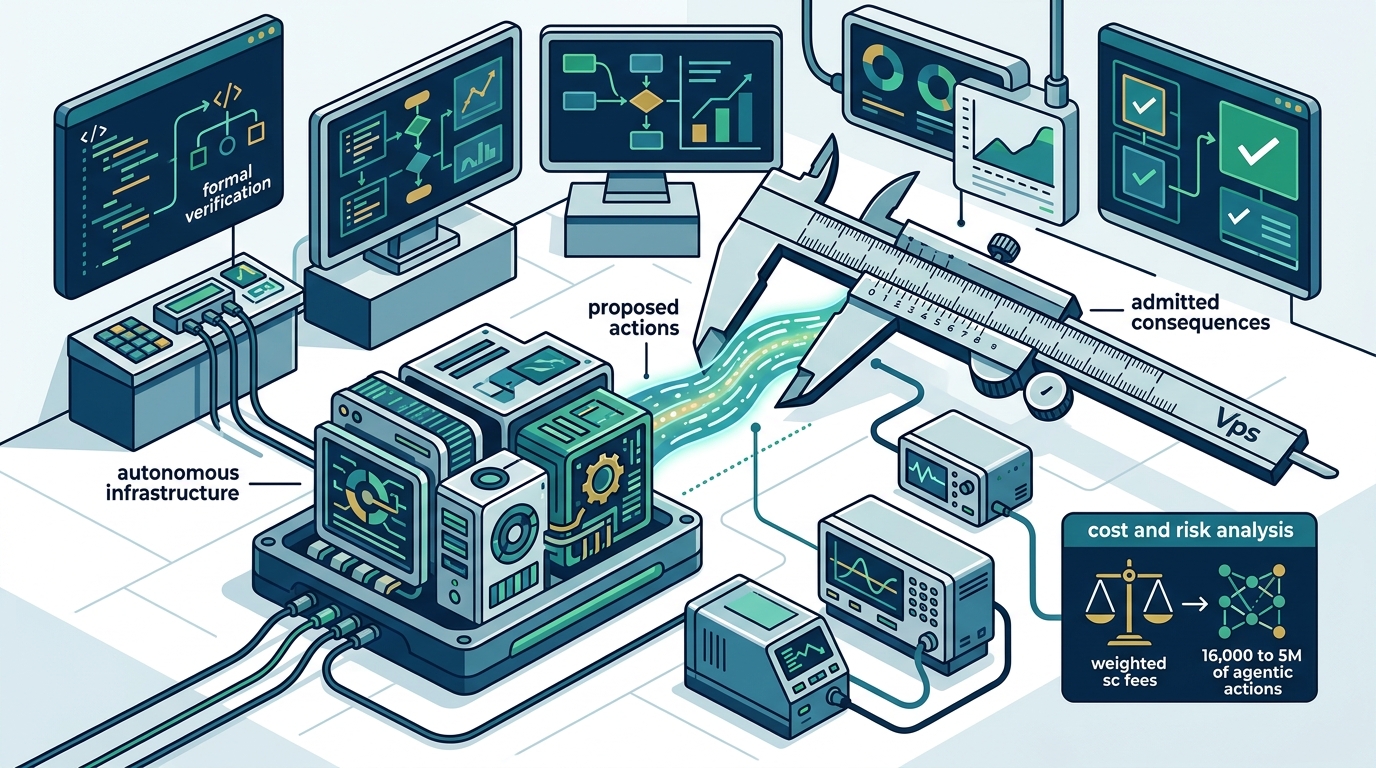
Plane A: Proposal
Untrusted entities propose actions. This includes models, planners, tools, and people. This plane holds no authority over production state. It is the source of candidate actions.
Plane B: Admission
A small, deterministic check evaluates the attempt. It checks the predicted effect against a fixed policy. This is where the metrics are generated. The system calculates whether the five assurance conditions are met.
Plane C: Execution
Minimal execution carries out only what Plane B authorized. It records the outcome. The entire process is designed to be low-latency. It happens in real-time, before the consequence occurs.
The time taken is negligible for the admission check. The value is in the record. The system creates a durable decision record before any effect. This record is the primary metric for system effectiveness.
What It Costs: What Drives the Price Up or Down
Verifiable Proof Systems offers a four-week, fixed-fee pilot. This pilot runs on one of your systems. It closes with a letter of intent if the criteria agreed in week one are met. The price is fixed, not hourly. This removes the uncertainty of consulting fees.
What drives the price up is the number of boundaries you need to secure. What drives it down is the clarity of your constraints. If your system has well-defined limits, the admission check is simpler. The cost is an investment in preventing high-stakes failures. It is not a subscription to a dashboard. It is a design partnership.
What Goes Wrong: The Common Mistakes and How to Avoid Them
The most common mistake is treating outputs as proof. A model's fluent explanation is not proof. A passing unit test is not proof. A signed artifact from the proposing system is not proof. These are testimony about a proposal. None of them admit the transition.
Another mistake is relying on lagging runtime telemetry. Telemetry tells you what happened. It does not tell you if it should have happened. You need real-time admission checks. Avoid tools that only monitor after the fact. They are too slow to prevent damage.
Finally, avoid assuming that a safety filter is enough. A safety filter the command passed is not authority. It is a heuristic. Heuristics fail. Deterministic checks do not. Use tools that enforce hard constraints, not soft filters.
Versus Alternatives: How This Compares to the Alternatives
Traditional security tools focus on perimeter defense. They block external threats. They do not manage internal authority. Proof infrastructure manages the internal boundary. It controls who can do what, and when.
| Feature | Traditional Security | Verifiable Proof Systems |
|---|---|---|
| Primary Focus | External Threats | Internal Authority |
| Decision Logic | Heuristic Filters | Deterministic Admission |
| Metrics | Block Rates | Admission/Refusal Records |
| Verification | Periodic Audits | Continuous State |
The key difference is the metric. Traditional tools measure blocks. Verifiable Proof Systems measures authority. It tracks the validity of every action. This is a more precise measure of system effectiveness.
For a Specific Situation: How the Answer Changes for a Particular Case
For teams preparing for the EU Cyber Resilience Act, the approach changes. The main obligations apply from 11 December 2027. You need evidence of continuous monitoring. Verifiable Proof Systems provides this evidence. It produces records that show where the evidence stops.
For financial systems, the focus is on payment authorization. The boundary must be tight. The metrics must show that every payment was authorized by a verified identity. For industrial systems, the focus is on setpoint changes. The metrics must show that the change was within declared constraints.
The specific situation dictates the constraints. The infrastructure remains the same. The policy changes. This flexibility is a key advantage. You can adapt the boundary to your specific risk profile.
Rules and Protections: The Rules, Rights or Protections That Apply
The primary protection is the durable decision record. This record is tamper-evident. It is not tamper-proof. The paper states this clearly. Auditable does not mean correct. But it means you can detect changes. This is a critical distinction.
Legal protections come from the evidence. If you can show that a decision was made under a fixed policy, you have a defense. This is not legal advice. It is a technical fact. The record supports your position. It shows you followed your own rules.
Intellectual property protections are also relevant. VPS is preparing an NSF SBIR/STTR Phase I proposal. This indicates a formal research path. It protects the underlying methods. You are working with a team that is building a defensible foundation.
Local Specifics: What Is Specific to the Areas Served
Verifiable Proof Systems is based in Florence, Oregon. This location is specific to the research community. It is close to Oregon State University. This proximity facilitates collaboration. The local ecosystem supports formal methods and runtime verification.
The local community is a strength. It provides access to talent and research. It is a hub for AI security. This is a unique advantage for a research initiative. It is not a commercial service provider. It is a research platform.
Timing: When to Act and How Timing Changes the Outcome
Timing is critical. The cost of an incident increases over time. The more autonomous your system becomes, the higher the risk. You should act now. The four-week pilot is a low-risk way to start. It gives you a baseline. It shows you where your boundaries are weak.
The outcome changes based on when you start. Early adoption gives you a competitive advantage. It shows you are serious about safety. It builds trust with your customers. It is a signal of maturity. This is a key differentiator in the 2026 market.
Results Over Time: Measurable Outcomes and What to Expect Long Term
Long-term results are measured in reduced incident frequency. The metrics show a trend. Over time, the refusal rate should stabilize. The admission rate should reflect your actual business needs. This is a sign of a healthy system.
ROI is measured with each partner against a baseline agreed in week one. This is a fair and transparent method. It avoids inflated claims. It focuses on real outcomes. The long-term goal is a system that is both effective and verifiable. This is a high bar. It is achievable with the right infrastructure.
Key Takeaways
- Verifiable Proof Systems provides built-in metrics for system effectiveness.
- The core metric is the admission versus refusal rate.
- Authority is bounded permission, not model confidence.
- The decision record is the primary evidence of compliance.
- Costs are driven by complexity and scope, not hours.
- Traditional security tools do not manage internal authority.
- Timing is critical; act before scaling autonomy.
- Long-term results are measured in reduced incident frequency.
Frequently Asked Questions
What is verifiable authority?
Verifiable authority is bounded permission over a named object, under explicit limits. It is established independently of the proposer.
How does the admission check work?
The admission check is a small, deterministic check of the attempt and its predicted effect, under a fixed policy. It happens in real-time.
What are the five assurance conditions?
The five conditions are independent evidence, bounded authority, verified identity, state continuity, and declared constraints. All must be met for admission.
Is the system formally verified?
The paper is a conceptual framework. It reports no model-checking or proof results. Formal models are in development for a companion paper.
How much does the pilot cost?
The pilot is a four-week, fixed-fee engagement. The exact cost depends on the scope of the system being assessed.
Can I audit the decision records?
Yes. Every decision at the boundary is recorded, including refusals. These records are durable and tamper-evident.