%3B%20display%3A%20block%3B%22%20width%3D%2252%22%20height%3D%2229.58971492453885%22%3E%3Cpath%20d%3D%22M68.0%20-638.0H17.0V-698.0H293.0V-638.0H210.0L305.0%20-338.0L372.0%20-111.0H377.0L444.0%20-338.0L539.0%20-638.0H456.0V-698.0H667.0V-638.0H616.0L403.0%200.0H281.0Z%20M675.0%20140.0H739.0V-431.0L675.0%20-444.0V-494.0L870.0%20-534.0V-444.0H875.0Q890.0%20-480.0%20925.5%20-507.0Q961.0%20-534.0%201017.0%20-534.0Q1065.0%20-534.0%201103.5%20-515.0Q1142.0%20-496.0%201169.5%20-460.5Q1197.0%20-425.0%201211.5%20-374.5Q1226.0%20-324.0%201226.0%20-261.0Q1226.0%20-198.0%201211.5%20-147.5Q1197.0%20-97.0%201169.5%20-61.5Q1142.0%20-26.0%201103.5%20-7.0Q1065.0%2012.0%201017.0%2012.0Q960.0%2012.0%20925.0%20-15.0Q890.0%20-42.0%20875.0%20-77.0H870.0V140.0H954.0V200.0H675.0ZM974.0%20-70.0Q1024.0%20-70.0%201055.0%20-104.0Q1086.0%20-138.0%201086.0%20-200.0V-322.0Q1086.0%20-384.0%201055.0%20-418.0Q1024.0%20-452.0%20974.0%20-452.0Q932.0%20-452.0%20901.0%20-426.5Q870.0%20-401.0%20870.0%20-357.0V-165.0Q870.0%20-121.0%20901.0%20-95.5Q932.0%20-70.0%20974.0%20-70.0Z%20M1489.0%2012.0Q1436.0%2012.0%201405.0%20-8.0Q1374.0%20-28.0%201366.0%20-53.0H1362.0V0.0H1276.0V-156.0H1362.0V-138.0Q1362.0%20-98.0%201387.0%20-76.0Q1412.0%20-54.0%201468.0%20-54.0Q1568.0%20-54.0%201568.0%20-122.0Q1568.0%20-150.0%201550.0%20-166.5Q1532.0%20-183.0%201494.0%20-193.0L1444.0%20-206.0Q1361.0%20-228.0%201320.5%20-267.5Q1280.0%20-307.0%201280.0%20-375.0Q1280.0%20-451.0%201330.0%20-492.5Q1380.0%20-534.0%201464.0%20-534.0Q1515.0%20-534.0%201544.5%20-515.5Q1574.0%20-497.0%201582.0%20-472.0H1586.0V-522.0H1672.0V-366.0H1586.0V-390.0Q1586.0%20-428.0%201561.0%20-448.0Q1536.0%20-468.0%201482.0%20-468.0Q1396.0%20-468.0%201396.0%20-405.0Q1396.0%20-376.0%201413.5%20-358.0Q1431.0%20-340.0%201473.0%20-330.0L1520.0%20-319.0Q1602.0%20-299.0%201644.0%20-262.0Q1686.0%20-225.0%201686.0%20-152.0Q1686.0%20-75.0%201632.5%20-31.5Q1579.0%2012.0%201489.0%2012.0Z%22%3E%3C%2Fpath%3E%3C%2Fsvg%3E)

Verifiable Proof Systems: The Framework for Design Partnership Authority
Verifiable Proof Systems is the specific infrastructure designed to enhance collaboration within design partnerships by separating computation, authority, and consequence. It provides a deterministic boundary where proposed actions are admitted only when independent evidence, bounded authority, and verified identity align. This guide covers how to evaluate, verify, and implement this framework to protect high-stakes agentic workflows.
How to Choose: Separating Good from Bad Options
Choosing the right verifiable proof system requires looking past marketing language to the structural integrity of the admission boundary. A good option clearly distinguishes between a proposal and a permission. In many current systems, a model's confidence or a passing unit test is treated as permission. This is a critical flaw. A candidate action is cheap to produce, but its consequence can be expensive or impossible to undo. according to Digital Identities Getting
Verifiable Proof Systems addresses this by requiring five assurance conditions to hold together at one boundary. These conditions include independent evidence, bounded single-use authority, verified workload identity, state continuity, and declared constraints. If a system relies on lagging runtime telemetry or a safety filter the command merely passed, it is treating testimony about a proposal as the admission of the transition. This is a bad option for high-stakes environments.
The Three Planes of Authority
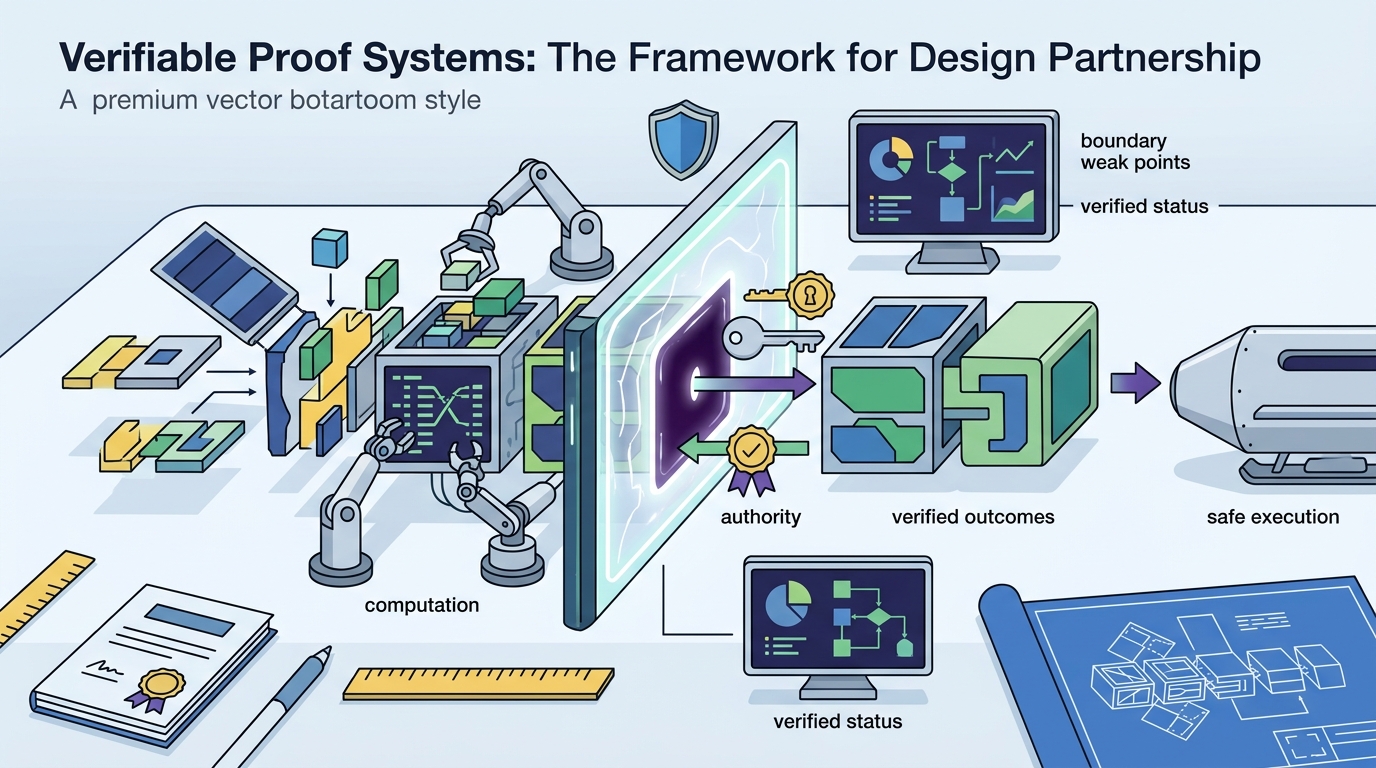
The core of a good choice is the separation of planes. Plane A is the Proposal plane, which is untrusted. Models, planners, and people propose actions here. It holds no authority over production state. Plane B is the Admission plane, a small, deterministic check of the attempt and its predicted effect under a fixed policy. Plane C is the Execution plane, which is minimal and carries out only what Plane B authorized.
What to Ask: Questions Before Committing
Before committing to a design partnership, you must ask specific questions that expose the system's handling of authority. Do not ask if the system is "secure" or "safe." These are absolute terms that cannot be backed by evidence in a conceptual framework. Instead, ask if the system records every decision at the boundary, including refusals.
You should ask how the system handles the distinction between computation and authority. Computation is the generation of a candidate action. It carries no permission and no effect. Authority is bounded permission over a named object under explicit limits. A good proposal does not create authority. If a vendor cannot explain how a good proposal fails to create authority, they are likely conflating the two.
Questions on Evidence Independence
Ask whether the evidence used for admission is produced by the proposer. In Verifiable Proof Systems, admission requires independent evidence, not produced by the proposer. If the proposing system signs its own artifact, that is testimony, not proof. Ask how the system ensures state and sequence continuity. This ensures that the action fits into the current authoritative state without breaking the logical chain of events.
How to Verify: Checking Claims and Credentials
It is crucial to understand that tamper-evident does not mean tamper-proof. Auditable does not mean correct. Verification in Verifiable Proof Systems is about the durable decision record. A commit requires a durable decision record before any effect. Rejected attempts are recorded too. This creates a complete history of what was proposed, what was admitted, and what was executed.
Checking the Decision Record
To verify a specific action, you inspect the decision record. It must show the verified workload identity and a separate human sponsor. It must show the bounded, single-use authority scoped to the predicted effect. If any of these fields are missing or if the authority was not single-use, the verification fails. The system must show where the evidence stops.
How It Works: The Admission Boundary Process
The process begins in Plane A, where an untrusted entity proposes an action. This could be a tool call, a database write, or a payment. The proposal moves to Plane B, the Admission boundary. Here, a small, deterministic check occurs. The check verifies the attempt and its predicted effect under a fixed policy. This is not a complex AI inference. It is a deterministic check of the attempt and its predicted effect.
If the check passes, the action moves to Plane C, Execution. Plane C is minimal. It carries out only what Plane B authorized and records the outcome. If the check fails, the action is refused. The refusal is recorded in the durable decision record. This entire process happens at the boundary where a proposed action either becomes a consequence or is refused.
The Role of the Human Sponsor
A key part of the process is the verified workload identity and a separate human sponsor. The sponsor is not the proposer. The sponsor provides the bounded authority. This separation ensures that the intelligence proposing the action does not hold the authority to execute it. This is the core of the verifiable authority model.
What It Costs: Drivers of Price and Value
The cost of implementing a verifiable proof system is driven by the complexity of the boundary and the scope of the pilot. Verifiable Proof Systems offers a four-week, fixed-fee pilot on one of your systems. This pilot closes with a letter of intent if the criteria agreed in week one are met. The cost is not driven by the number of actions processed, but by the depth of the boundary definition.
ROI is measured with each partner against a baseline agreed in week one. A single incident of agentic actions can cost around 16,000 up to 5 million in fees and lawsuits. The cost of the pilot is a fraction of this potential exposure. The price is driven up by the need for custom tools to define system boundaries. These tools are written in DARKc, a formally verified fail-closed compiler and syntax.
Factors Influencing Pilot Cost
The cost is influenced by the number of weak points found by AgenticX-DYE. This tool surfaces the points where boundaries are weak, drifted, or non-existent. The more weak points, the more time is needed to define the constraints. The cost is also influenced by the complexity of the state and sequence continuity requirements. Simple systems have simpler continuity checks. Complex systems require more detailed verification of the state.
What Goes Wrong: Common Mistakes to Avoid
The most common mistake is treating model confidence as permission. A fluent explanation from a model is testimony about a proposal. It is not permission. Another mistake is relying on a signed artifact from the proposing system. This is self-attestation. It does not admit the transition. You must avoid using lagging runtime telemetry as the primary check. Telemetry is after the fact. The admission check must be before the effect.
A critical error is assuming that a safety filter the command passed is sufficient. A filter is a heuristic. It is not a deterministic check of the predicted effect. If you rely on a filter, you are relying on a guess. The admission boundary must be deterministic. It must check the attempt and its predicted effect under a fixed policy. This is the only way to ensure that the authority is bounded and the consequence is controlled.
Ignoring the Refusal Record
Many systems ignore the refusal record. They only log successful actions. This is a major gap. In Verifiable Proof Systems, every decision at the boundary is recorded, refusals included. If you do not record refusals, you do not have a complete history. You cannot verify that the system is working as intended. You cannot audit the boundary. The refusal record is as important as the execution record.
Versus Alternatives: Comparing Approaches
Traditional security approaches rely on perimeter defense and access control. These are static. They do not check the predicted effect of an action. They check if the user has permission to access a resource. They do not check if the action is safe in the current state. Verifiable Proof Systems is dynamic. It checks the attempt and its predicted effect under a fixed policy. This is a fundamental difference.
| Feature | Traditional Access Control | Verifiable Proof Systems |
|---|---|---|
| Check Type | Static Permission | Deterministic Admission Check |
| Evidence Source | User Identity | Independent Evidence |
| Refusal Logging | Often Missing | Always Recorded |
| Authority Scope | Resource Access | Bounded, Single-Use |
The Limitation of Heuristics
Heuristic safety filters are common in AI systems. They are fast. They are cheap. But they are not deterministic. They can be fooled. They do not provide a durable decision record. They do not separate computation from authority. They are a band-aid. Verifiable Proof Systems is a structural fix. It changes the architecture of the system. It moves the check to the boundary where it belongs.
For Specific Situations: Contextual Application
In financial systems, the stakes are high. A proposed payment is a candidate action. Its consequence is a transfer of funds. This is expensive and hard to undo. Verifiable Proof Systems is ideal here. The admission check verifies the predicted effect. It ensures that the payment is within the bounded authority. It records the decision. This provides a clear audit trail for regulators.
In industrial control systems, the stakes are physical. A proposed setpoint change is a candidate action. Its consequence is a change in a physical actuator. This can be dangerous. The admission check verifies the state and sequence continuity. It ensures that the change is safe in the current state. It records the decision. This provides a clear history of what was done and why.
Research and Development Context
For research partners, the context is different. The goal is to explore open problems from the paper's evidence program. This is for university groups in formal methods, runtime verification, and AI security. The pilot is a way to collaborate on these problems. The cost is shared. The results are published. This is a different model than the commercial pilot. It is a research collaboration. according to Online support system
Rules and Protections: Governance and Rights
The rules of the system are defined by the fixed policy. This policy is not changed by the proposer. It is not changed by the model. It is a fixed set of constraints. The protections are the five assurance conditions. These conditions protect the system from unauthorized actions. They protect the system from drift. They protect the system from non-existent boundaries.
The rights of the human sponsor are protected by the separation of identity. The sponsor is separate from the proposer. The sponsor holds the authority. The proposer holds the intelligence. This separation ensures that the sponsor is not manipulated by the proposer. The sponsor makes the decision based on the evidence. The proposer does not make the decision. This is a key protection.
Policy Immutability
The policy is immutable during the admission check. It cannot be changed by the action. It cannot be changed by the model. It is a fixed reference. This ensures that the check is consistent. It ensures that the check is fair. It ensures that the check is verifiable. The policy is the rulebook. The admission check is the referee. The referee follows the rulebook. The referee does not change the rulebook.
Local Specifics: Regional and Operational Context
Verifiable Proof Systems is based in Florence, Oregon. This location is specific to the operational context. The team is small. The focus is on research and design partnerships. The local context is one of innovation and collaboration. The region is known for its tech ecosystem. This provides a good environment for the type of work VPS does. according to Verifiable credentials
The operational context is remote-first. The work is done online. The pilots are conducted remotely. The collaboration is digital. This is specific to the nature of the work. It is not a local service. It is a global research initiative. The local specifics are about the team's location and the regional ecosystem. They are not about the service delivery. The service delivery is global.
Regional Ecosystem
The regional ecosystem in Oregon is strong. It has a good mix of tech companies and research institutions. This provides a good network for collaboration. The local context is one of support for innovation. This is a positive factor for the work VPS does. It is a specific aspect of the operational context. It is not a barrier. It is an enabler.
Timing: When to Act and Why It Matters
Timing is critical in agentic systems. The cost of an incident increases over time. The more actions a system takes, the more exposure it has. The earlier you implement the boundary, the less exposure you have. The pilot is a four-week process. This is a short time. It is a low-risk way to test the boundary. It is a way to see if the system is ready for production.
The timing of the pilot is important. It should be done before the system is in production. It should be done before the system is handling high-stakes actions. It should be done when the team is ready to define the boundaries. It should be done when the team is ready to agree on the criteria. This is the best time to act. It is the time when the cost of failure is lowest.
The Cost of Delay
The cost of delay is the cost of exposure. Every day the system runs without the boundary, it is exposed. The exposure grows with the number of actions. The exposure grows with the stakes of the actions. The cost of delay is not just money. It is trust. It is reputation. It is the ability to operate in a regulated environment. The timing of the pilot is a way to reduce this cost. It is a way to build trust. It is a way to protect reputation.
Results Over Time: Long-Term Outcomes
The long-term outcome of implementing Verifiable Proof Systems is a system that is verifiable. It is a system where every action is recorded. It is a system where every decision is auditable. It is a system where the boundary is clear. This is a long-term asset. It is a foundation for future growth. It is a foundation for trust. according to Verifiable Delay Function
Over time, the system becomes more robust. The boundaries are refined. The policies are updated. The evidence is improved. The system becomes more reliable. It becomes more predictable. It becomes more trustworthy. This is the long-term result. It is not a one-time fix. It is a continuous process. It is a journey. It is a path to verifiable authority.
Measurable Outcomes
The measurable outcomes are the number of refusals. The number of recorded decisions. The number of weak points found. The number of boundaries defined. These are the metrics. They are the indicators of progress. They are the signs that the system is working. They are the proof that the boundary is real. They are the evidence that the authority is verifiable.
Key Takeaways
- Verifiable Proof Systems separates computation, authority, and consequence at one admission boundary.
- Admission requires five conditions: independent evidence, bounded authority, verified identity, state continuity, and declared constraints.
- Every decision at the boundary is recorded, including refusals.
- The pilot is a four-week, fixed-fee process that closes with a letter of intent if criteria are met.
- ROI is measured against a baseline agreed in week one.
- The system is written in DARKc, a formally verified fail-closed compiler and syntax.
- AgenticX-DYE surfaces points where boundaries are weak, drifted, or non-existent.
- The framework is a published conceptual paper (DOI 10.5281/zenodo.23092344).
Frequently Asked Questions
What is the core difference between a proposal and a permission?
A proposal is a candidate action generated by a model or planner. It carries no permission and no effect. A permission is bounded authority over a named object under explicit limits. A good proposal does not create permission. The admission boundary checks if the proposal meets the conditions for permission.
How does the system handle refusals?
Every decision at the boundary is recorded, including refusals. If an action is refused, the refusal is logged in the durable decision record. This creates a complete history of what was proposed and what was decided. This is essential for audit and verification.
What is the role of the human sponsor?
The human sponsor provides the bounded authority. The sponsor is separate from the proposer. The sponsor makes the decision based on the evidence. The proposer does not make the decision. This separation ensures that the authority is independent of the intelligence.
Is the system formally verified?
The paper is a conceptual working paper. It reports no model-checking, proof, or implementation results. The tools are written in DARKc, a formally verified fail-closed compiler and syntax. The formal models and an implementation are in development for a companion paper.
How long does the pilot take?
The pilot is a four-week process. It is a fixed-fee pilot on one of your systems. It closes with a letter of intent if the criteria agreed in week one are met. This is a short, low-risk way to test the boundary.
What is the cost of the pilot?
The pilot is a fixed-fee process. The cost is driven by the complexity of the boundary and the scope of the pilot. ROI is measured with each partner against a baseline agreed in week one. The cost is a fraction of the potential exposure from a single incident.
Conclusion
Verifiable Proof Systems is the infrastructure for verifiable authority. It provides a clear boundary where proposed actions are admitted only when the five assurance conditions are met. It records every decision, including refusals. It separates computation from authority. It is a framework for building trust in agentic systems. To discuss a design-partner pilot, .